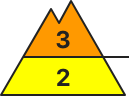
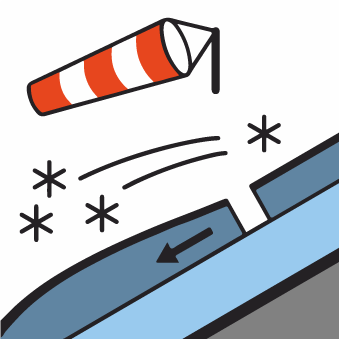
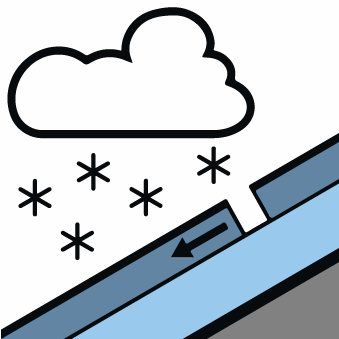
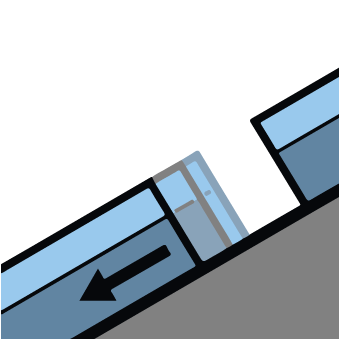
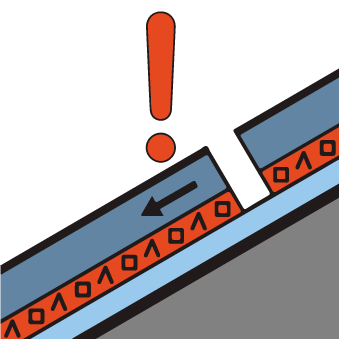
Avalanche prone locations are often covered in snow and difficult to recognise.
The avalanche risk is considerable above 1800 metres and moderate below that. The main problem is the new and wind slab snow of the last few days. Medium-sized slab avalanches can be triggered in many places with little additional load. The avalanche prone locations are in the steep terrain adjacent to ridgelines in all aspects of the slope, behind terrain edges and in gullies and bowls. They become more frequent with increasing altitude. Self-triggering of medium loose snow avalanches is possible from steep terrain interspersed with rocks, especially when the sun is shining.
On very steep meadow slopes and in sparse mountain forests, small and medium-sized gliding avalanches can release themselves.
Snowpack
Over the last few days, many prone-to-triggering snowdrift accumulations have formed. They lie on weak layers of soft snow and graupel. These layers become more prone to triggering with increasing altitude. In addition, the wind slab is often covered with snow and difficult to recognise. At higher altitudes, there are weak layers in the area of melting snow caps in places. Low-lying layers of faceted crystals are difficult to disturb. Towards the ground, the snow is often wet and can slide off on slippery surfaces. With the slight warming and sun, the surface snow also quickly becomes moist and heavy.
Tendency
Slow decline in the drift snow problem.
Danger level
1800m
Avalanche Problem
New snow
1800m
Wind slab
1800m
Persistent weak layer
1800m
New snow
1800m
New and blown snow
New fallen snow and blowing snow are the main dangers. Snowpack stability is reduced, especially on slopes and in ravines, where the snow thickness is greater due to snow accumulations.
In addition to new fallen snow, weak layers in the snowpack deeper in the snowpack can be a local problem. These weak layers are more common in the axis above the forest. In particular, a large avalanche can be triggered if the load exceeds the load-bearing capacity of these layers.
Snowpack
dp.4: cold following warm / warm following cold
15-30 cm of dry and light snow fell in the mountains. A strong northerly wind blew in with the snow, blowing the snow down to the old base in many places. The new fallen snow is only slowly bonding with the old base. Ridges and peaks are blown down to the old base, in some places there is little old base. During the precipitation more than a week ago, there was some local fall of Graupel, which is a potentially dangerous Weak layer. Locally, the layers of Graupel are 5-10 cm thick, possibly more.
In old snow cover, the snow layers are mostly well connected. Deep below the surface, several weak layers of shreds and sheared grains occur, which are more frequent on axial slopes.
Tendency
The danger of avalanches will remain similar.
Friday will clear and winds will ease. The weekend will be warm and mostly sunny.
Danger level
1800m
Avalanche Problem
New snow
1800m
Gliding snow
Fresh snow and older drifts prone to triggering
Fresh fallen and frequently covered older snowdrift accumulations are easily triggered. Slab avalanches can be triggered by minimum additional loading and grow to medium-sized releases. Settling noises when treading the snowpack and fractures on the surface are indicators of imminent danger. Danger zones occur in wind-loaded steep terrain, behind sharp drops in the landscape, in gullies and bowls. In very steep terrain, loose-snow avalanches are possible due to solar radiation and daytime warming.
Snowpack
The fresh snow and drifts from recent days frequently blanket older snowdrift accumulations. Amid intermittently strong winds it will be transported and will generate new snowdrift masses. They are prone to triggering. Fresh snow and drifts often lie deposited atop soft layers of fresh fallen snow from precious days and blanket older drifts. The old snowpack is generally well consolidated and compact.
Tendency
Gradually receding avalanche danger
Danger level
2000m
Avalanche Problem
New snow
2000m
Gliding snow
2000m
Persistent weak layer
2200m
Fresh snow and drifts prone to triggering
Fresh fallen snow and snowdrift accumulations are easily triggered. Slab avalanchess can be triggered by minimum additional loading and grow to medium-sized releases. Settling noises when treading the snowpack and fractures on the surface are indicators of imminent danger. Danger zones occur in wind-loaded steep terrain, behind sharp drops in the landscape, in gullies and bowls. Particularly in high-altitude west, north and east-facing slopes, avalanches can fracture down to ground-level layers of the snowpack and grow to large size. In very steep terrain, also loose-snow avalanches are possible due to solar radiation and daytime warming.
Snowpack
Fresh fallen snow and snowdrifts frequently lie deposited atop older snowdrift accumulations. Amid intermittently strong winds it will be transported and will generate new snowdrift masses, especially in high-altitude pass and ridgeline zones. They are prone to triggering. The mid-part of the snowpack consists of well-consolidated, compact layers which in shady slopes blanket a poorly-structured snowpack fundament.
Tendency
Gradually receding avalanche danger
Danger level
treeline
Avalanche Problem
Wind slab
Treeline
Persistent weak layer
2000m
Significant avalanche danger - avoid wind slab!
The avalanche risk is still considerable above the tree line. Prone to triggering are snowdrift accumulations caused by strong and, in the higher altitudes, stormy winds in recent days, some of which are more extensive. In almost all aspects, medium slab avalanches can still be triggered in steep slopes, in filled steep bowls and gullies by low additional loads. If layers in persistent weak layers are exposed, some of the slab avalanches can also become large. Naturally triggered avalanches are only possible in isolated cases.
Snowpack
The recently fallen new snow has been transported by strong and, in exposed locations, stormy winds and is not binding sufficiently. The thinly covered wind slab can still contain weak layers and is therefore prone to triggering. In very high north-facing or on shady slopes, the snow base, fundament (persistent weak layer problem) is partially weakened.
Tendency
The drifting snow problem is slowly receding.
Danger level
treeline
Avalanche Problem
Wind slab
Treeline
Persistent weak layer
2000m
Prone to triggering wind slab snow, persistent weak layer problem in the higher elevations
The avalanche risk is considerable from the sparse high forest upwards and low below. The wind slab is prone to triggering and can be triggered in many places with little additional load; slab avalanches can reach medium size. All aspects and both adjacent to ridgelines and steep terrain far from ridgelines are affected. Drift snow areas are partly covered with snow and difficult to recognise. Caution is also required on and below cornices.
At high altitudes (especially on western, northern and eastern slopes), avalanches can also break through into the persistent weak layer and occasionally become large if there is a lot of additional load. Be careful at transitions from lots of snow to little snow.
Snowpack
In windless areas, there is 20 to 40 cm of new fallen snow from the last few days, depending on the area, while exposed places are heavily blown and snowdrift accumulations are correspondingly thick. Underneath is settled wind slab snow from the last week. This came to rest on an old snowpack, which is interspersed with faceted crystals and deep rime (also in combination with crusts) both in the transition area and deeper inside. This weakens the structure down to ground level. Although fractures are still possible here, they are most likely to occur within the fresh snow packs.
Tendency
Mixed weather leads to a slow reduction in avalanche danger.
Danger level
1600m
Avalanche Problem
Wind slab
1600m
Persistent weak layer
1800m
Still considerable avalanche danger at higher altitudes!
The avalanche danger above 1600 m is assessed as "considerable". Persistent winds lead to extensive snowdrift accumulations, some of which are prone to triggering. Avalanche prone locations are mainly in gullies, bowls and behind ridgelines and terrain edges and sometimes extend down into forest aisles. Aspects from north to east to south are particularly affected. The drifting snow layer can be triggered in some places by a small additional load as a mostly medium-sized slab avalanche. Occasionally, large avalanches can also occur.
Snowpack
The new fallen snow and winds of the past few days have created snowdrift accumulations, some of which are very thick and are deposited on a largely stable old snowpack. The proneness to triggering of weak layers in the windslab snow is decreasing, but weak layers in the transition to persistent weak layers and in the snow base, fundament are still possible, especially on the north side.
Tendency
On Friday, there will still be a few clouds from the north, but it will soften a little during the daytime changes. In the south of the Alps, it will be cloudy in the morning and sunny in the afternoon. The wind slab problem will slowly subside.
Danger level
treeline
Avalanche Problem
Wind slab
Treeline
Gliding snow
2000m
The wind slab of the last few days is often covered in snow and therefore difficult to recognise.
The avalanche risk is considerable above the tree line and low below it. The main problem is wind slab avalanches. Medium-sized slab avalanches can be triggered in many places with little additional load. The avalanche prone locations are mainly above the tree line in steep terrain adjacent to ridgelines in all slope aspects, behind terrain edges and in gullies and bowls. They become more frequent with increasing altitude.
Smaller gliding avalanches can detach themselves on individual, very steep meadow slopes. Smaller loose snow avalanches come off the steep terrain interspersed with rocks, especially when the sun is shining.
Snowpack
Over the last few days, many prone-to-triggering snowdrift accumulations have formed. They lie on soft layers of snow and graupel. These layers have not yet been able to consolidate well, especially at higher altitudes. The wind slab is often covered by soft new fallen snow and is difficult to recognise. At higher elevations, weak intermediate layers are embedded in the snowpack in the area of melted snow caps. Deeper layers of faceted crystals are difficult to disturb. Towards the ground, the snow is often wet and can slide off on a smooth surface. With the slight warming and sunshine, the surface snow also quickly becomes moist and heavy.
Tendency
Slow easing of the drifting snow problem.
Danger level
1200m
Avalanche Problem
Wind slab
1200m
Danger from fresh wind slab increases with altitude!
The avalanche risk at higher altitudes is moderate (level 2). Fresh wind slab avalanches can be triggered in places even with a small additional load. Slab avalanches are mainly triggered at the transition to old snowpack.
Avalanche prone locations are in gullies, bowls and behind terrain edges as well as down into forest aisles. The wind slab covers existing avalanche prone locations, which often makes them difficult to recognise.
The avalanche prone locations increase with altitude.
Slab avalanches can reach medium size.
Snowpack
In the past week, snow has repeatedly fallen in combination with strong to stormy winds. The new fallen snow was transported intensively and formed drift snow packs. Exposed areas are often heavily blown down.
The fresh drift and new fallen snow is poorly bonded to the old snowpack in some places. In some places, there are also weak layers within the wind slab.
In shady high altitudes, there are still faceted crystals or floating snow in the persistent weak layer in places, but these are currently hardly prone to triggering and do not pose a significant avalanche problem.
Tendency
The avalanche danger will remain the same for the time being. However, the avalanche situation is expected to change as temperatures rise towards the weekend.
Danger level
treeline
Avalanche Problem
Wind slab
Treeline
Persistent weak layer
2000m
Avoid prone to triggering wind slabs
The avalanche risk is moderate above the tree line. Wind slabs can be triggered as small or medium-sized slabs in all aspects, even with low loads. Avalanche prone locations are mainly in gullies, bowls and behind terrain edges (also distant from ridgelines), as well as on and below cornices.
Take particular care on very steep west, north and east-facing slopes above around 2000 metres, especially where there is a transition from little to more snow. There are still isolated trigger points lurking in the persistent weak layer.
Snowpack
The snow surface is variable and characterised by storms. Drift snow packs are usually easily recognisable, but the unfavourable old snowpack underneath is not. Breaks are possible between the drift snow layers and at the transition to the persistent weak layer. The old snowpack is particularly weakened on western, northern and eastern slopes above around 2000 metres due to layers of faceted crystals and deep frost as well as a foundation of floating snow close to the ground.
Tendency
Mixed weather leads to a slow reduction in avalanche danger.
Danger level
treeline
Avalanche Problem
Wind slab
Treeline
Avoid wind slab!
The avalanche risk is predominantly moderate above the tree line. However, snowdrift accumulations caused by the strong, sometimes stormy winds of the last few days should be noted. In almost all aspects, medium slab avalanches can still be triggered in some places on steep slopes, in filled steep bowls and gullies by low additional loads. Naturally triggered avalanches are only possible in isolated cases.
Snowpack
The recently fallen new snow has been transported by strong and, in exposed locations, stormy winds and is not binding sufficiently. The freshly covered wind slab can also contain weak layers and is therefore prone to triggering.
Tendency
The drifting snow problem is slowly receding.
Danger level
treeline
Avalanche Problem
Wind slab
Treeline
Persistent weak layer
1800m
Still wind slab problem in the high altitudes!
The avalanche danger is rated as "moderate" above the tree line. There, fresh snowdrift accumulations can still be triggered as slab avalanches by low additional loads. Medium-sized avalanches are typically expected. The avalanche prone locations are on lee slopes behind terrain edges and in steep gullies and bowls.
Snowpack
Strong winds are still forming fresh snowdrift accumulations. These are located on a mostly stable old snowpack. There are weak layers in the wind-driven snow and occasionally, in shady high altitudes, also in the snow base, fundament (persistent weak layer problem).
Tendency
On Friday, there will still be a few clouds from the north, but it will soften a little during the daytime changes. In the south of the Alps, it will be cloudy in the morning and sunny in the afternoon. The avalanche risk will change only slightly.
Danger level
treeline
Avalanche Problem
Wind slab
Treeline
Avoid prone to triggering wind slabs
The avalanche risk is moderate. Above the tree line, the wind slab can be triggered as a snow slab in some places even with little additional load, below it is relatively well set. Avalanches can reach medium size. There are avalanche prone locations both adjacent to ridgelines and distant from ridgelines, as well as in steep gullies and in forest aisles. Drift snow areas are sometimes covered in snow and difficult to recognise. Also be careful on and below cornices.
Snowpack
In wind-calmed higher elevations, there is 20 to 30 cm of new fallen snow from the last few days, depending on the area, in some places even over 40 cm, while exposed places are heavily blown and snowdrift accumulations are correspondingly thick. Underneath is settled wind slab snow from the last week. On shady slopes, there are angular shapes and deep rime (also in combination with crusts) deeper in the old snowpack. Breaks are still possible here, especially with large additional loads, but are most likely to occur within the fresh drift snow packs.
Tendency
Mixed weather leads to a slow reduction in avalanche danger.
Danger level
treeline
Avalanche Problem
New snow
Treeline
Wind slab
Treeline
Wet snow
New and blown snow
New fallen snow and blowing snow are the main dangers. The snowpack stability is reduced, especially on slopes and in ravines, where the snow thickness is greater due to snow accumulations.
Snowpack
dp.4: cold following warm / warm following cold
On Thursday and Friday, 40-60 cm of snow fell in the mountains, which was dry above about 1000 m and wetter at lower altitudes. The snowfall was accompanied by strong northerly winds, which blew the snow above the snow line to the old snow base or ground in many places.
During the precipitation of more than a week ago, there was local fall of graupel, which is a potentially dangerous Weak layer. Locally, the layers of Graupel are 5-10 cm thick, possibly more.
In an old snow cover, the snow layers are well interconnected.
Tendency
The danger of avalanches will remain similar.
Friday will clear and winds will ease. The weekend will be warm and mostly sunny.
Danger level
treeline
Avalanche Problem
Wind slab
Treeline
Gliding snow
Wind slab is covered by soft snow and can still be released in places.
The avalanche risk is moderate above the tree line and low below it. The main problem is wind slab. Small to medium slab avalanches can sometimes be triggered with little additional load. The avalanche prone locations are mainly above the tree line in the steep terrain adjacent to ridgelines in all slope aspects, behind terrain edges and in gullies and bowls. They are often covered in snow and difficult to recognise.
On very steep meadow slopes, small gliding avalanches can usually detach themselves. Small loose snow avalanches come off the steep terrain interspersed with rocks, especially when the sun is shining.
Snowpack
Small-scale snowdrift accumulations have formed over the last few days. They are prone to triggering on soft layers and graupel. In addition, weak intermediate layers are occasionally embedded in the upper part of the old snowpack in the area of melting snow caps. The snowpack base is compact and largely stable. At the boundary to the ground, it is often wet, which means that the snowpack can slide on smooth ground. With the slight warming and sunshine, the surface snow also quickly becomes moist and heavy.
Tendency
The wind slab problem is increasingly easing with the settlement of the snowpack.
Danger level
1500m
Avalanche Problem
Wind slab
1500m
Low avalanche danger, but avoid fresh pillows of wind drifted snow!
The avalanche danger is assessed as "low". Nevertheless, isolated pillows of wind drifted snow can be triggered as small slab avalanches.
Snowpack
Persistent winds still lead to the formation of small pillows of wind drifted snow, which are deposited on a hard old snowpack and are usually sufficiently bonded to it. There is generally little snow.
Tendency
On Friday, it will be cloudy on the south side of the Alps in the morning and sunny in the afternoon. The avalanche risk remains low.
Danger level
Low avalanche danger, but avoid fresh pillows of wind drifted snow!
Pillows of wind drifted snow are occasionally prone to triggering and can be triggered by individuals as a small slide. However, the risk of burial is low.
Snowpack
There have been repeated snowfalls on the Hochwechsel and in the Bucklige Welt in the last few days in conjunction with mostly strong to stormy winds. The new fallen snow was transported intensively and deposited as wind slab, especially in forest aisles and at higher altitudes.
Where there is an old snowpack, the drift snow packs are deposited on it and can slide off. In addition, fractures within the drift snow layers are also possible in isolated cases.
Tendency
The avalanche danger remains the same.
Danger level
Pay attention to the wind slab problem!
The fresh wind slab is prone to triggering in places and can be triggered by even a small additional load. Avalanche prone locations are mainly found in gullies, bowls and behind terrain edges down to forest aisles.
Slab avalanches can reach medium size.
Snowpack
In the past week, snow has repeatedly fallen in combination with strong to stormy winds. The new fallen snow was transported intensively and formed drift snow packs.
Where there is an old snowpack, the drift snow packs are deposited on it and can slide off. In addition, fractures within the drift snow layers are also possible in isolated cases.
In places protected from the wind, there is up to 60 cm of snow in places above around 800 m, which has built up over the last week. Exposed locations, on the other hand, are often heavily blown off.