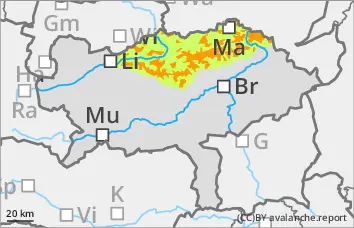
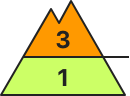
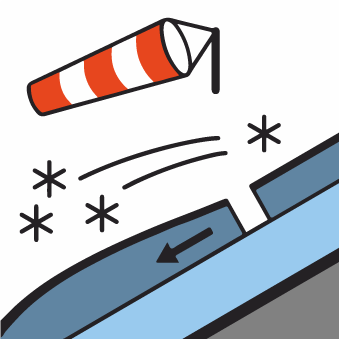
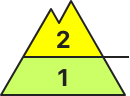
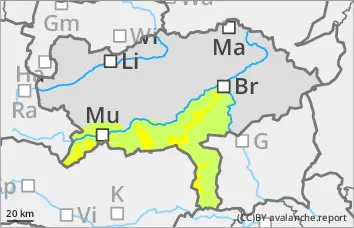
The avalanche danger is assessed as considerable (level 3) above 1500 metres. The extensive snowdrift accumulations are prone to triggering, especially above the tree line. The main problem is wind slab. The avalanche prone locations are adjacent to ridgelines and far from ridgelines. They are mainly located in gullies, bowls and behind terrain edges. The layer of drifting snow can be triggered by individual winter sports enthusiasts as a medium-sized avalanche. Loose snow avalanches are also possible in isolated cases.
Snowpack
The cold temperatures at high altitude are preserving the snow layering. A lot of snow has been transported in the last few days. More snow will also fall on Sunday! The eastern and southern aspects are particularly affected. The wind slab has not yet been able to settle. The snowdrift accumulations are deposited above the tree line on a partly still weak old snowpack. Weak layers are in the bound layer or transition to the old snow, in higher elevations in places still in the persistent weak layer (faceted crystals in the area of crusts).
Tendency
The wind slab problem will persist.
With a northerly high-altitude current, it will remain cloudy and often snowy along the northern side of the Alps throughout Holy Week. Although conditions are dry south of the main Alpine ridge, it is usually cloudy and windy here too.
Danger level
treeline
Avalanche Problem
Wind slab
Treeline
Take particular care in the east and south sectors!
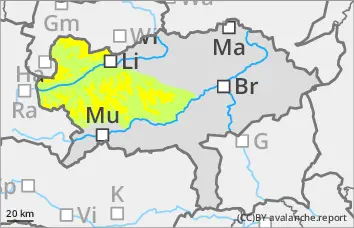
The avalanche danger is rated as moderate above the tree line. The stormy wind has formed fresh wind slabs that are easily recognisable. Above the tree line, the fresh wind slab can easily be triggered as a snow slab. Typically, medium avalanches are expected to be triggered. The avalanche prone locations are adjacent to ridgelines as well as distant from ridgelines and in steep gullies and bowls. Loose snow avalanches are possible from steep rocky and rugged terrain.
Snowpack
The strong to gale-force winds have worked the new fallen snow (up to 60 cm). The wind slab is usually quite hard. Weak layers are to be expected within the drift snow layer. The old snowpack is mostly hard and close to the ground the snowpack is weakened by floating snow.
Tendency
With a northerly high-altitude current, it will remain cloudy and often snowy along the northern side of the Alps throughout Holy Week. Although conditions are dry south of the main Alpine ridge, it is usually cloudy and windy here too.
Danger level
treeline
Avalanche Problem
Wind slab
Treeline
Beware of fresh wind slab!
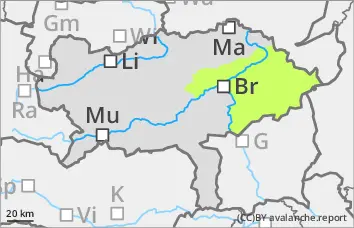
The avalanche risk is moderate above the tree line. Fresh snowdrift accumulations can be triggered as small to medium-sized avalanches by individual winter sports enthusiasts in all aspects. The avalanche prone locations are mainly in gullies, bowls and behind terrain edges.
Snowpack
Fresh snowdrift accumulations are often deposited on a sufficiently stable old snowpack above the tree line. Weak layers are located in the bound layer or transition to the persistent weak layer, in some places still in the old snow at higher altitudes.
Tendency
The wind slab problem remains.
Although conditions are dry south of the main Alpine ridge, it is mostly cloudy and windy here too.
Danger level
Fresh pillows of wind drifted snow!
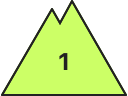
The avalanche danger is assessed as low. Fresh pillows of wind drifted snow can be triggered as a slide.
Snowpack
A few centimetres of new fallen snow or wind slabs have been deposited on a hardness of old snowpack. There is generally little snow.
Tendency
No significant change in the avalanche danger is expected.