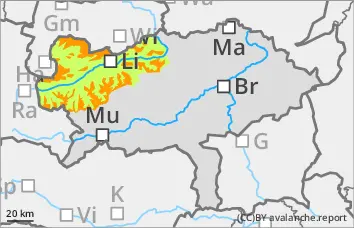
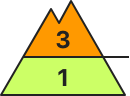
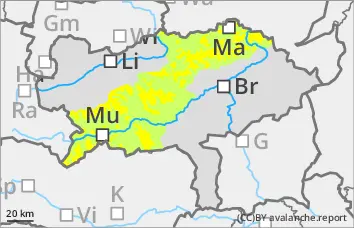
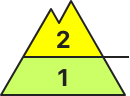
The avalanche risk increases rapidly with altitude and is assessed as considerable above the tree line. The persistent weak layer problem is still present and is currently exacerbated by fresh wind slab. The avalanche prone locations are from north-west to south-east on slopes that have been blown in, in terrain adjacent to ridgelines and at the entrances to gullies and bowls. Medium-sized slab avalanches can be triggered by individuals.
Snowpack
Up to 30 cm of new fallen snow has fallen since Saturday, with a few centimetres more to come on Tuesday. Stormy north-westerly winds led to extensive drifting. Some of the fresh wind slab snow contains weak layers and the snow base, fundament is weakened by snow-covered surface hoar and floating snow.
Tendency
It will remain largely free of precipitation on Wednesday and the frost at higher altitudes will weaken. On Thursday, an Adriatic low pressure system from the south-west will bring snow and rain at low altitudes. No change in the avalanche risk for the time being.
Danger level
treeline
Avalanche Problem
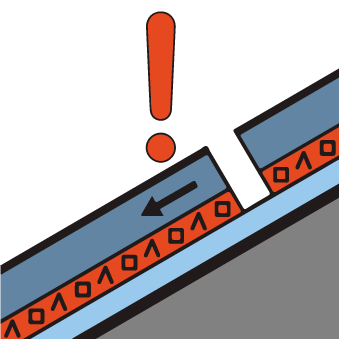
Persistent weak layer
Treeline
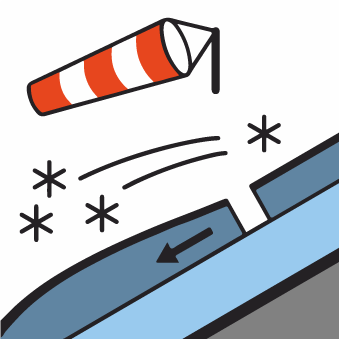
Wind slab
Fresh wind slab leads to an increase in avalanche danger above the tree line!
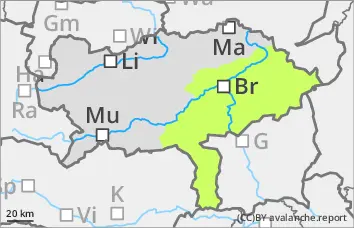
The avalanche risk is moderate above the tree line and low below. The persistent weak layer problem is still present and is currently exacerbated by a little fresh wind slab. The avalanche prone locations are mainly on north to south-east facing slopes above the tree line. Here, fresh and older snowdrift accumulations can be triggered by individuals as slab avalanches in a few places.
Snowpack
Up to 15 cm of new fallen snow has fallen in the north since Saturday, with a few centimetres more to come over the course of Tuesday. Stormy north-westerly winds led to drifts. The snow base, fundament is weakened by snow-covered surface hoar and floating snow.
Tendency
It will remain largely free of precipitation on Wednesday and the frost at higher altitudes will weaken. On Thursday, an Adriatic low pressure system from the south-west will bring snow and rain at low altitudes. No change in the avalanche risk for the time being.
Danger level
Avalanche Problem
Wind slab
Little new fallen snow.
Low avalanche danger, but beware of fresh pillows of wind drifted snow!
The avalanche risk is low. Small slab avalanches can be triggered in extremely steep gullies and bowls in isolated places at high altitudes.
Snowpack
A little new fallen snow and strong winds led to the formation of pillows of wind drifted snow. The wind slab lies on a hardness of old snowpack or on a soft layer. In the higher elevations, angular snow crystals continue to weaken the stability on shady slopes.
Tendency
It will remain largely free of precipitation on Wednesday and the frost at higher altitudes will weaken. On Thursday, an Adriatic low pressure system from the south-west will bring snow and rain at low altitudes.
The avalanche risk will remain low for the time being.