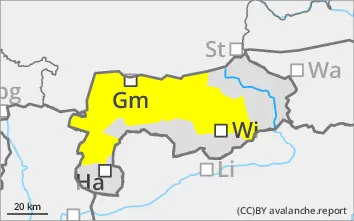
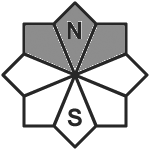
The avalanche risk is predominantly moderate at altitudes where there is still a sufficiently thick snowpack. From steep terrain that has not yet been discharged, spontaneous or moist to wet medium loose snow or slab avalanches triggered by additional load are possible in all aspects.
Snowpack
With only limited outgoing longwave radiation, the snow surface can hardly firmness. With the mild temperatures and incoming radiation, it loses firmness during the day. The snowpack is moist to wet up to high altitudes.
Tendency
No significant change in the avalanche situation.
Danger level
Avalanche Problem
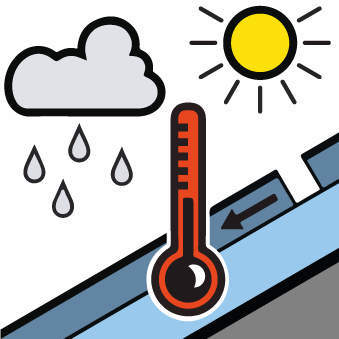
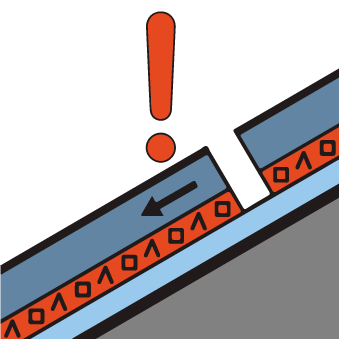
Wet snow
Persistent weak layer
2200m
Furthermore, spontaneous wet snow avalanches from undischarged terrain must be taken into account!
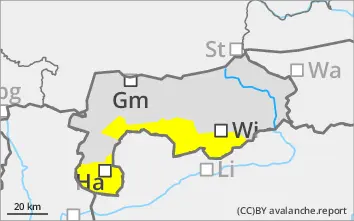
The avalanche risk is predominantly moderate where there is still a sufficiently thick snowpack. From steep terrain that has not yet been discharged, spontaneous or moist to wet medium loose snow or slab avalanches triggered by additional loads are possible in all aspects. In the shady, very high elevations, slab avalanches can still be triggered occasionally in very steep terrain due to the old snow problem.
Snowpack
With only limited outgoing longwave radiation, the snow surface can hardly firmness. With the mild temperatures and incoming radiation, it continues to lose firmness during the day. The snowpack is moist to wet up to high altitudes. However, weak layers may still be present in the old snowpack, which is not yet moist, only at the top and on shady slopes.