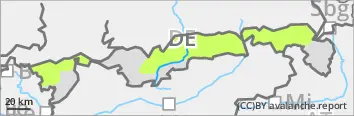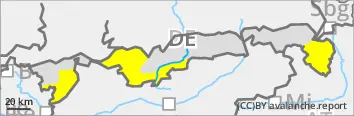
Danger level
 |
|  |  | |||||
|  |
|  |
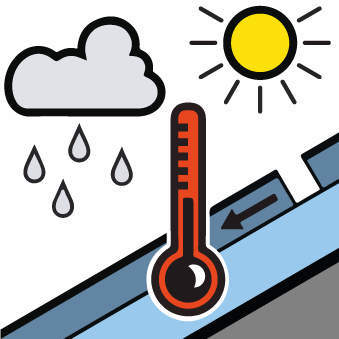


Wet snow is an issue all day long.
The avalanche risk is moderate. Wet snow is the main problem. Wet loose snow and slab avalanches release themselves, especially on extremely steep terrain. Occasional wet gliding avalanches can also occur on steep slopes with a smooth surface. Sliding snow cracks indicate the danger. Wet avalanches reach medium size and sometimes have long run-out lengths. Persistent weak layers can still be problematic at high altitudes. On a few steep slopes with aspects from north-west to north to east, medium slab avalanches can be triggered by low additional loads.
Snowpack
With reduced outgoing longwave radiation, the snow surface does not freeze through everywhere. It softens again in the morning with the sunlight. Even in the northern aspects of higher altitudes, the surface snowpack is slightly to heavily soaked, depending on the slope gradient. In some places, there are potential weak layers in the area of crusts in the upper metres of the snowpack at high altitudes. The snowpack base is still dry in places at high altitudes and often consists of faceted crystals. At medium altitudes, it is mostly wet. On the south side, the ground is increasingly pitting up to medium altitudes.
Tendency
The avalanche danger hardly changes. Wet avalanches remain an issue.