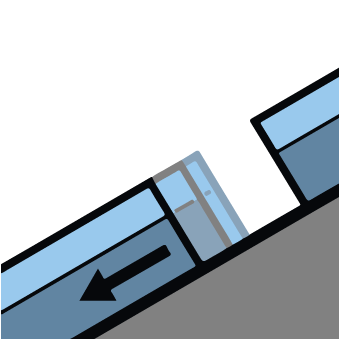
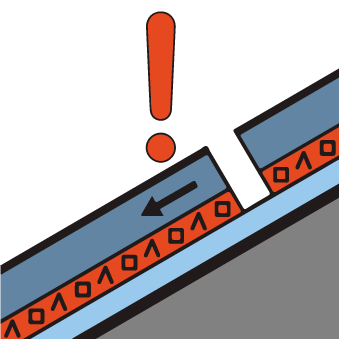
The wind slab can be triggered even with a small additional load
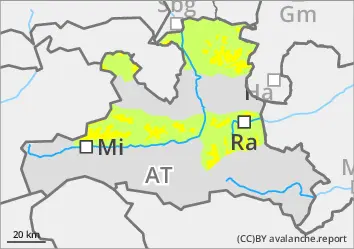
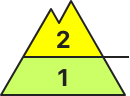
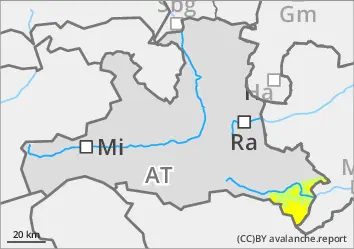
The avalanche risk is moderate. Above the tree line, the fresh wind slab can be triggered as a slab in some places even with a small additional load. Avalanches can reach medium size. There are avalanche prone locations both adjacent to ridgelines and distant from ridgelines, as well as in steep gullies and in forest aisles. The wind slab is partly covered with snow away from areas adjacent to the ridgeline, crest or summit and the avalanche prone locations are not recognisable everywhere. Spontaneous small gliding avalanches are possible on very steep grassy slopes.
Snowpack
The new fallen snow (widespread 40 cm to 60 cm, occasionally around 80 cm) that fell in the middle of the week under the influence of strong winds from the west to north has settled significantly. On the sunny slopes, the snow is often lying on previously apery soils up to medium altitudes, on shady slopes on an old snowpack weakened by angular forms (partly also on crusts) and near the ground (deep rime). Fractures are mainly possible within the fresh drift snow layers, but in shady high altitudes sometimes also on faceted layers in the persistent weak layer. On very steep sunny slopes, some of the snow glides along the ground.
Tendency
Poor visibility on Monday and further snow showers from the northwest during the day changes. Little change for the time being.
Danger level
treeline
Avalanche Problem
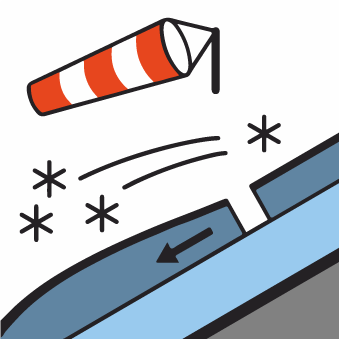
Wind slab
Treeline
Persistent weak layer
2000m
Consistently avoid fresh wind slab!
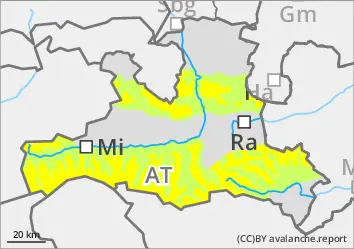
The avalanche risk is moderate above the tree line. Fresh wind slabs can be triggered as small or medium-sized slabs in all aspects, even under low loads. Avalanche prone locations are mainly in gullies, bowls and behind terrain edges, also distant from ridgelines. Take particular care on very steep western, northern and eastern slopes above around 2000 metres. Transitions from little to more snow are particularly unfavourable.
Snowpack
Stormy north-westerly winds characterise the snowpack and constantly form fresh wind slabs. The wind slab covers an unfavourable old snow surface above the tree line. The old snowpack is weak, especially on western, northern and eastern slopes above around 2000 metres, faceted crystals and a floating snow foundation close to the ground weaken the structure.
Tendency
No significant change on Monday.
Danger level
treeline
Avalanche Problem
Wind slab
Treeline
Persistent weak layer
2000m
Avalanche prone locations in wind slab, in the higher altitudes also in persistent weak layers
The avalanche risk is moderate from the sparse high forest upwards. The last wind slab can be triggered in some places with little additional load, slab avalanches can reach medium size. All aspects and both adjacent to ridgelines and steep terrain far from ridgelines are affected. At high altitudes (especially on western, northern and eastern slopes), avalanches can also break through into the persistent weak layer and occasionally become large if the additional load is high. Poor visibility makes it difficult to recognise avalanche prone locations. At low and medium altitudes, individual gliding avalanches are also possible.
Snowpack
The new fallen snow (widespread 40 to 60 cm, occasionally around 80 cm) that fell under stormy conditions from the west to north in the middle of the week has settled significantly and has already been slightly moistened on steep sunny slopes up to over 2000 metres. In exposed areas, the snowpack is marked by the storm. Fractures are possible, especially in the fresh wind slab, but also in the old snowpack, in which faceted crystals (some on crusts) and deep rime are weakening the structure both near the surface and deeper inside. This mainly affects high altitudes on shady slopes (W-N-E) and high alpine locations.
Tendency
Poor visibility on Monday and snow showers again during the daytime changes. Little change for the time being.