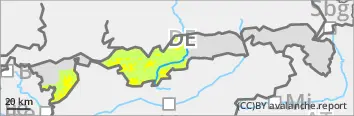
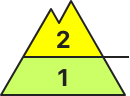
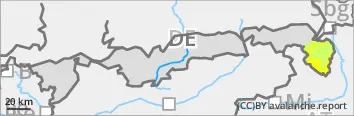
The avalanche risk is moderate above 1800 metres and low below. Wind slab is the main problem. In places, mostly small slab avalanches can be triggered with little additional load. This is possible above all in the steep terrain adjacent to ridgelines in the west, east and south-east aspects as well as in gullies and bowls.
On a few shady slopes at high altitudes, medium slab avalanches can also be triggered with a large additional load in persistent weak layers, for example when surface avalanches penetrate to deep layers.
When exposed to sunlight, small loose snow avalanches can release themselves from the steep terrain interspersed with rocks.
Snowpack
In places, fresh and older wind slab lies on a small scale on soft layers of snow or a thin crust and is then prone to triggering. In some places, it also lies directly on a load-bearing, crusted can form surface of old snow with which it has bonded well. On shady slopes at high altitudes, weak layers of faceted crystals can be found deep in the otherwise compact old snowpack. In the sun, the new fallen snow of the last few days becomes moist. The southern sides of the middle elevations are rapidly thawing out again.
Tendency
The avalanche danger is slowly decreasing.
Danger level
treeline
Avalanche Problem
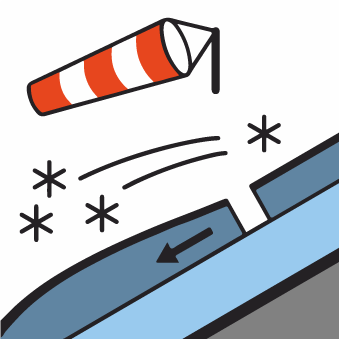
Wind slab
Treeline
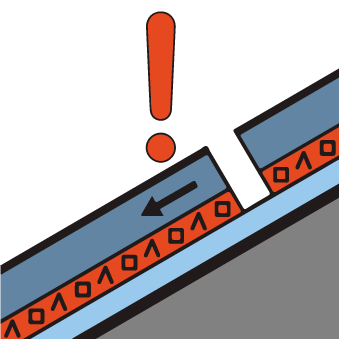
Persistent weak layer
2000m
Watch out for small-scale wind slabs and deep, built-up layers in the persistent weak layer.
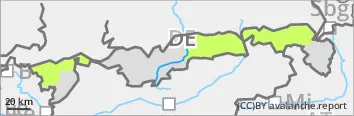
The avalanche risk is moderate above the tree line and low below. Wind slabs are the main problem. In places, small to medium slab avalanches can be triggered with a small additional load. This is possible above all in steep terrain adjacent to ridgelines in the west, east and south-east aspects as well as in gullies and bowls. The number and extent of avalanche prone locations increase with altitude.
On a few shaded slopes at high altitudes, medium slab avalanches can also be triggered with a large additional load in the persistent weak layer, for example when surface avalanches penetrate to deep layers.
When exposed to sunlight, small loose snow avalanches can detach themselves from the steep terrain interspersed with rocks.
Snowpack
Fresh and older wind slabs lie on small scales, sometimes on soft layers of snow or a thin crust, and are prone to triggering. On shady slopes at high altitudes, weak layers of faceted crystals can be found deep in the otherwise compact old snowpack. In the sun, the new fallen snow of the last few days becomes moist. The southern sides of the middle elevations are rapidly thawing out again.
Tendency
The avalanche danger is slowly decreasing.
Danger level
treeline
Avalanche Problem
Wind slab
Treeline
Small snowdrift accumulations can be prone to triggering. Be aware of the risk of falling.
The avalanche risk is low. Wind slab is the main problem. Small slab avalanches can be triggered in places with little additional load. The few avalanche prone locations are mainly in the steep terrain adjacent to ridgelines in the west, east and south-east aspects as well as in gullies and bowls.
With sunlight, individual, small loose snow avalanches can detach themselves from the rocky steep terrain. Small gliding avalanches are possible on smooth, steep meadow slopes.
Snowpack
Small-scale wind slabs are sometimes prone to triggering on soft layers of overblown new fallen snow. In most cases, however, it is well bonded directly on a crusted can form surface or the previously apery ground. The new fallen snow from the last few days quickly becomes damp in the sun. Overall, there is little snow.