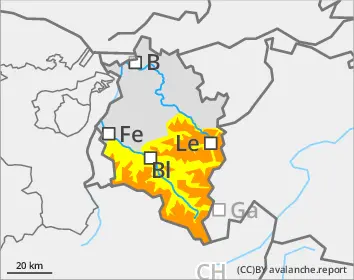
Beware fresh snow, drifts and weak layers on shady slopes: prone to triggering
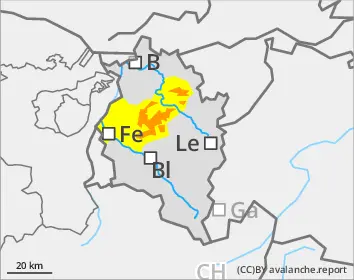
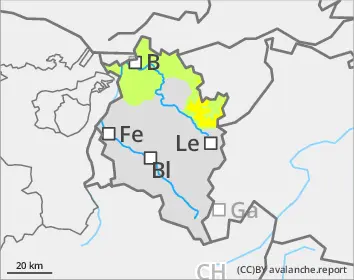
The fresh snow and drifts can trigger medium-sized avalanches even by minimum additional loading. Danger zones occur primarily in steep terrain and in wind-loaded gullies and bowls. Frequency and spread of avalanche prone locations increase with ascending altitude and during the course of the day. If avalanches on high-altitude shady slopes fracture down to deeper weak layers, they can in isolated cases then grow to large size. Such avalanche prone locations occur primarily in spots where the snow is shallow or in transitions from shallow to deep snow. Particularly if there is solar radiation, small-to-medium sized avalanches are possible in steep rocky terrain.
Snowpack
From Saturday until Sunday morning there was about 20cm of fresh snow registered in the Arlberg region, up to 25cm in Rätikon, Verwall and the Silvretta. As a result of brisk westerly winds, later on blowing at strong velocity, fresh snowdrift accumulations will be generated. These will be deposited on top of a loosely-pack layer and are prone to triggering. The mid-level part of the snowpack consists of well-settled, compact layers widespread which on high-altitude shady slopes cover a poorly structured old snowpack fundament.
Tendency
Avalanche danger will slowly diminish overall, however, intermittent N-NW winds will generate new snowdrift accumulations which will be prone to triggering. With solar radiation, the danger of wet-snow avalanches will increase over the course of each day.
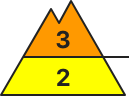
Danger level
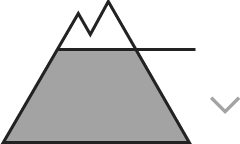
1800m
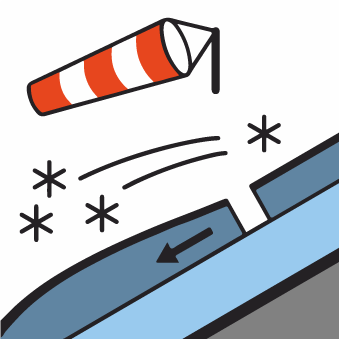
Avalanche Problem
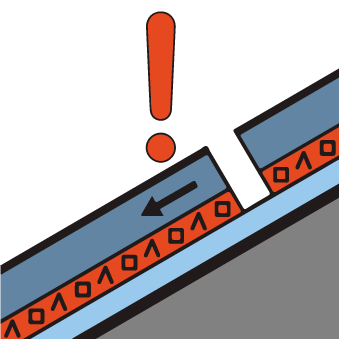
Wind slab
1800m
Wind slab
1800m
Beware snowdrifts: prone to triggering
The fresh snow and drifts can trigger medium-sized avalanches even by minimum additional loading. Danger zones occur primarily in steep terrain and in wind-loaded gullies and bowls. Frequency and spread of avalanche prone locations increase with ascending altitude and during the course of the day. If avalanches on high-altitude shady slopes fracture down to deeper weak layers, they can in isolated cases then grow to larger size. Particularly if there is solar radiation, small-to-medium sized avalanches are possible in steep rocky terrain.
Snowpack
From Saturday until Sunday morning there was about 20-30cm of fresh snow registered. As a result of brisk westerly winds, later on blowing at strong velocity, fresh snowdrift accumulations will be generated. These will be deposited on top of a loosely-pack layer and are prone to triggering. The mid-level part of the snowpack consists of well-settled, compact layers widespread which on high-altitude shady slopes cover a poorly structured old snowpack fundament.
Tendency
Avalanche danger will slowly diminish overall, however, intermittent N-NW winds will generate new snowdrift accumulations which will be prone to triggering. With solar radiation, the danger of wet-snow avalanches will increase over the course of each day.
Danger level
treeline
Avalanche Problem
Wind slab
Treeline
Beware snowdrifts: prone to triggering
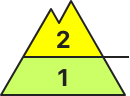
Avalanche danger above the timberline is moderate, below that altitude danger is low. Fresh snowdrift accumulations can trigger slab avalanches even by minimum additional loading. Danger zones occur primarily in steep terrain and in wind-loaded gullies and bowls. Frequency and spread of avalanche prone locations increase with ascending altitude and during the course of the day. If avalanches on high-altitude shady slopes fracture down to deeper weak layers, they can in isolated cases then grow to larger size. Apart from the risks of being buried in snow masses, the danger of being swept along and forced to take a fall require caution. Particularly if there is solar radiation, small-to-medium sized avalanches are possible in steep rocky terrain.
Snowpack
From Saturday until Sunday morning there was about 15-20cm of fresh snow registered. As a result of brisk westerly winds, later on blowing at strong velocity, fresh snowdrift accumulations will be generated. These will be deposited on top of a loosely-pack layer and are prone to triggering. The mid-level part of the snowpack consists of well-settled, compact layers widespread which on high-altitude shady slopes cover a poorly structured old snowpack fundament.
Tendency
Avalanche danger will slowly diminish overall, however, intermittent N-NW winds will generate new snowdrift accumulations which will be prone to triggering. With solar radiation, the danger of wet-snow avalanches will increase over the course of each day.