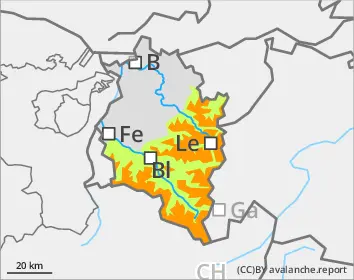
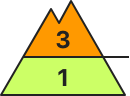
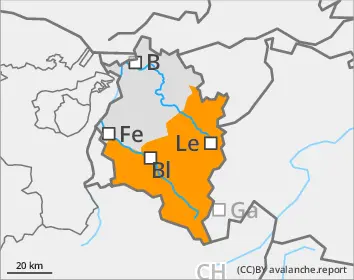
Daytime rise in wet-snow activity. Backcountry touring terrain: weak old snow.
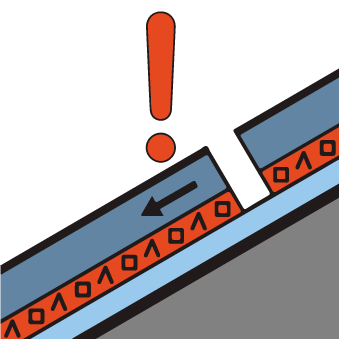
Well settled fresh snow and drifts blanket a weak old snowpack. Where the surface cannot bear loads, avalanches can be triggered even by one single winter sports enthusiast, esp. in little-skied terrain on west-, north- and east-facing slopes. Danger zones occur especially. in places where snow is shallow and in transitions from shallow to deep snow, as well as near ridgelines. Remote triggerings are possible. Avalanches can grow to large size, then flow over flat slope passages. Due to daytime warming and solar radiation, wet loose-snow avalanches can be expected, especially. on steep south-facing slopes below 2200m. On west and east-facing slopes where there is little now, these can fracture down to deeper layers and then grow to large size. On steep grass-covered slopes, glide-snow avalanches can release. Zones with glide cracks should under all circumstances be avoided.
Snowpack
The deep fresh snow and drifts of last week have settled well for the most part. Due to nocturnal outgoing radiation, a melt-freeze crust forms which is often capable of bearing loads on sun-exposed slopes up to 2200m. In the lowermost part of the snowpack widespread are large-sized cup-shaped crystals without any bonding. The unusual avalanche activity of last week confirms just how prone to triggering the old snowpack really is, and apart from heavily-skied routes this trigger-sensitivity persists in starting zones which have not yet discharged.
Tendency
As a result of high-pressure weather conditions, the daytime rise in avalanche danger persists. The situation for winter sports enthusiasts remains treacherous in little-skied terrain.
EARLIER Danger level
1800m
Avalanche Problem
Persistent weak layer
1800m
LATER Danger level
Avalanche Problem
Wet snow
Persistent weak layer
1800m
Wet-snow avalanches during the course of the day
Due to daytime warming and solar radiation, wet loose-snow avalanches can be expected in steep terrain. Wherever there is lots of snow on the ground, these releases can grow to large size. On steep grass-covered slopes, glide-snow avalanches can occur. Zones with glide cracks on the surface should under all circumstances be avoided. Particularly on very steep shady slopes above 1800m, avalanches can fracture down to deeper-down layers inside the snowpack in isolated cases.
Snowpack
Wherever there is still snow on the ground, it is thoroughly moist-to-wet and forms a melt-freeze crust during the nocturnal hours. Only above 1800m on shady slopes are there still weak layers in places in the lower most part of the snowpack.
Tendency
As a result of high-pressure weather conditions, the daytime rise in avalanche danger persists.