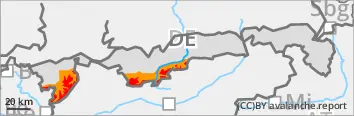
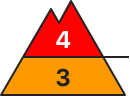
The avalanche risk is high above 1800 metres and considerable below that. The main problem is the large amount of new fallen snow from the past week. Slab avalanches can be triggered in all aspects and altitudes by a small additional load. In very steep terrain at higher altitudes, they can also detach themselves. In extremely steep, rocky terrain, the new fallen snow is released in the form of loose snow avalanches. Avalanches can become large and penetrate as far as the flats.
Wet snow is also problematic. Due to the rainfall up to 1800 m, spontaneous loose snow avalanches of medium size can be expected from very steep terrain. On steep slopes with smooth ground, such as on meadow slopes, rock slabs or in gappy deciduous forests, gliding avalanches can be expected below open snow pockets. Exposed transportation routes can be hit by wet avalanches.
Snowpack
Snowdrift accumulations can be found in all aspects. At higher altitudes, they often lie on graupel, old surface hoar, soft intermediate layers or in the area of thin crusts on faceted crystals. Above 1800 m, there are weak layers of faceted crystals in the snowpack on shady slopes. Up to around 1800 m, the snowpack becomes soaked through rainfall. At medium altitudes, the base of the snowpack is usually wet.
Tendency
The avalanche situation remains tense.
Danger level
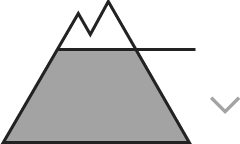
1800m
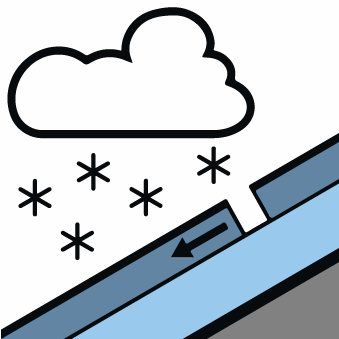
Avalanche Problem
Wet snow
1800m
New snow
1500m
Slab avalanches can still be triggered by individual skiers.
The avalanche risk is considerable. The main problem is wet snow. Below 1800 m, gliding avalanches on steep slopes with smooth ground, such as on mountain meadows, in gappy deciduous forest or on rock slabs, release themselves. Staying in areas below glide cracks should be avoided. Wet loose snow avalanches mainly occur in extremely steep terrain. Wet avalanches can reach medium size and hit exposed transportation routes.
The new snow problem must also be taken into account above 1500 metres. Medium-sized slab avalanches can be triggered on steep slopes of all aspects by low additional loads. The proneness to triggering increases with increasing altitude.
Snowpack
Up to 1800 m, the soaking of the snowpack by rain is progressing. At medium altitudes, the snowpack base is mostly wet. In addition, snowdrift accumulations can be found in all aspects. At higher altitudes, they are often prone to triggering on graupel, old surface hoar, soft intermediate layers or in the area of thin crusts on faceted crystals. Above 1800 m, there are weak layers of faceted crystals in the snowpack on shady slopes.