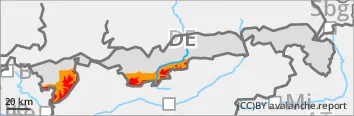
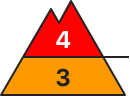
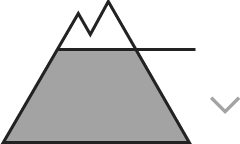
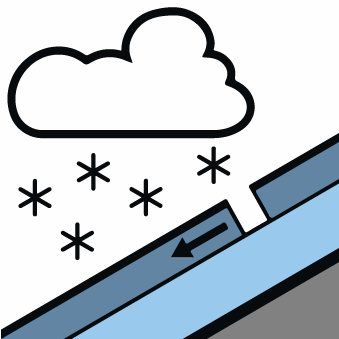
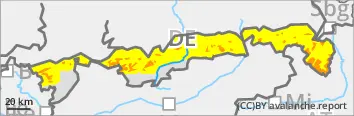
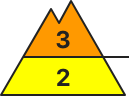
The avalanche risk is high above 1600 metres and considerable below that. The main problem is new fallen snow. Avalanches can break loose in all aspects and altitudes, either by themselves or with a small additional load. There is even a risk of avalanches in steep clearings or aisles in mountain forests. From extremely steep terrain, new fallen snow is released in the form of loose snow avalanches. Avalanches can become large and penetrate as far as the flat.
Wet snow also becomes a problem. During the daytime changes, spontaneous loose snow avalanches of medium size can be expected up to 1400 m due to rainfall from very steep terrain, such as forest aisles.
Gliding avalanches are also possible on very steep slopes with smooth ground.
Exposed transportation routes can be hit by avalanches.
Snowpack
Soft new fallen snow lies over large snowdrift accumulations that are prone to triggering. North-westerly winds are creating fresh wind slabs. In all aspects, there are potential weak layers of graupel, surface hoar or faceted crystals in the area of thin crusts in the upper part of the snowpack. Above 1800 m, there are weak layers of faceted crystals in the snowpack on the shady slopes. Up to approx. 1400 m, rainfall weakens the snowpack during the day changes. At medium altitudes, the snowpack base is partly moist or wet. The snow depths vary greatly across the terrain due to the strong winds.
Tendency
The avalanche situation remains tense.
Danger level
1500m
Avalanche Problem
New snow
1500m
New snow
1500m
Wet snow
1400m
Avoid prone to triggering wind slab!
The avalanche risk is considerable above 1500 metres and moderate below that. The main problem is new fallen snow. Avalanches can be triggered in all aspects and altitudes by small additional loads. There is even a risk of avalanches in steep clearings or aisles in mountain forests. From extremely steep terrain, new fallen snow is released in the form of loose snow avalanches. The avalanche prone locations increase in number and size with altitude. Avalanches reach medium size.
Wet snow also becomes a problem. During the daytime changes, spontaneous loose snow avalanches of medium size can be expected from very steep terrain, such as forest aisles, due to the rainfall up to 1400 metres.
Gliding avalanches are also possible on very steep slopes with smooth ground.
Exposed transportation routes can be hit by avalanches.
Snowpack
Soft new fallen snow lies over prone to triggering snowdrift accumulations. North-westerly winds are creating fresh wind slabs. Potential weak layers of graupel, surface hoar or faceted crystals in the area of thin crusts can be found in the upper part of the snowpack in all aspects. Above 1800 m, there are weak layers of faceted crystals in the snowpack on the shady slopes. Up to approx. 1400 m, rainfall weakens the snowpack during the day changes. At medium altitudes, the snowpack base is partly moist or wet. The snow depths vary greatly across the terrain due to the strong winds.