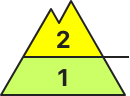
It is essential to pay attention to fresh loads prone to triggering and the persistent weak layer problem!
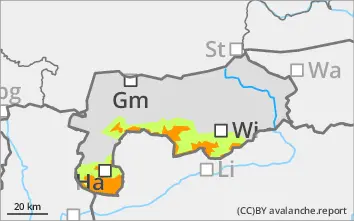
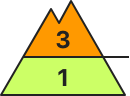
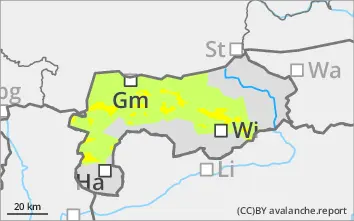
The avalanche risk is considerable in some areas above the tree line. In some areas in the eastern sector and on the south side, there are more extensive avalanches that can be triggered as medium slab avalanches in filled steep slopes and in steep bowls and gullies even with a small additional load. Hard-to-recognise individual avalanche prone locations due to the persistent weak layer problem are to be observed in northern to eastern steep slopes. Here, snow slabs can also be triggered by individuals. This applies to both drift and persistent weak layers.
Snowpack
Around 20 cm of new fallen snow may fall overnight. Strong winds from the northwest will form fresh, prone-to-triggering drifts that will bond poorly with the old snowpack. At higher elevations, the old snowpack remains largely unchanged with thin melt-freeze crusts and faceted crystals near the ground on the north and shady slopes, some of which are floating snow. The snowpack is still very unevenly distributed, even at higher altitudes there is only a little snow, often the new fallen snow falls on apery ground.
Tendency
No significant change. Pay attention to wind slabs
Danger level
treeline
Avalanche Problem
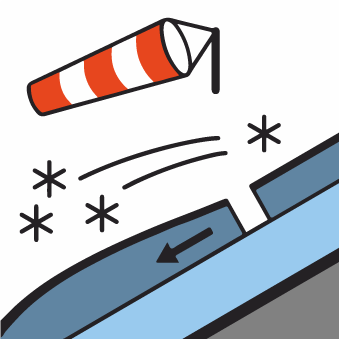
Wind slab
Treeline
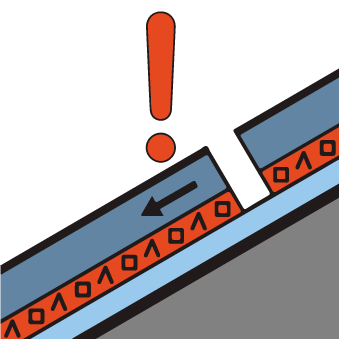
Persistent weak layer
1800m
Prone to triggering and the persistent weak layer problem must be taken into account!
The avalanche risk is moderate above the tree line. In some areas in the eastern sector and on the south side, there are more extensive avalanches that can be triggered as small to medium slab avalanches in filled steep slopes as well as in steep bowls and gullies even with a small additional load. Hard-to-recognise individual avalanche prone locations due to the persistent weak layer problem are to be observed in northern to eastern steep slopes. Here, snow slabs can also be triggered by individual people and tear through to the layer close to the ground.
Snowpack
Around 20 cm of new fallen snow may fall overnight. Strong winds from the northwest will form fresh, prone-to-triggering drifts that will bond poorly with the old snowpack. At higher elevations, the old snowpack remains largely unchanged with thin melt-freeze crusts and faceted crystals near the ground on the north and shady slopes, some of which are floating snow. The snowpack is still very unevenly distributed, even at higher altitudes there is only a little snow, often the new fallen snow falls on apery ground.
Tendency
No significant change. Pay attention to wind slabs