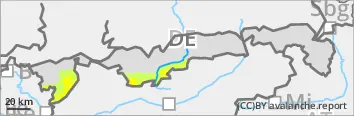
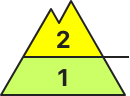
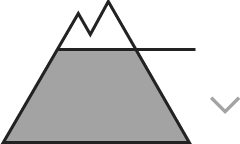
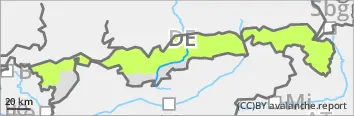
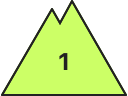
The avalanche risk is moderate above 2200 metres and low below. Persistent weak layers are problematic. Slab avalanches can be triggered in particular with large additional loads. Avalanche prone locations are located on very steep slopes with aspects from north-west to north to east as well as at the transition from little to much snow, for example when entering gullies and bowls. The number of avalanche prone locations increases with altitude. Avalanches can reach medium size at high altitudes.
Snowpack
At medium elevations, the snowpack can form a crust in the morning before softening with the sun during the daytime changes. On shady slopes at higher altitudes (above approx. 1500 m), the snow is well set and powdery. Weak layers of faceted crystals can be found in places under lower-lying harsch covers. On the south side, the ground is increasingly pitting.
Tendency
The avalanche danger is slowly decreasing.
Danger level
1800m
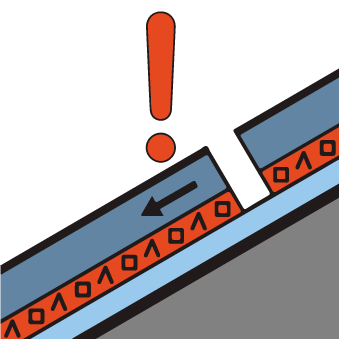
Avalanche Problem
Persistent weak layer
1800m
Risk of falling and injury on crust can form surfaces.
The avalanche risk is low. Occasional small slab avalanches can be triggered, in particular with large additional loads in the persistent weak layer. Avalanche prone locations are located above around 1800 m on extremely steep shady slopes. The risk of falling and injury is greater than the danger of burial.
Snowpack
At medium elevations, the snowpack can form a crust in the morning before softening with the sun over the course of the daytime changes. On shady slopes at higher altitudes (above approx. 1500 metres), the snow is well settled and powdery. Large, faceted crystals often form the snow base, fundament. The south-facing slopes are largely snowed out.