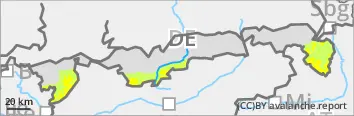
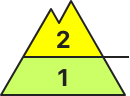
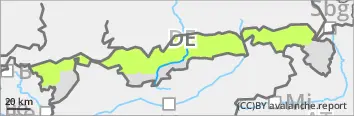
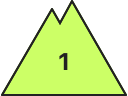
The avalanche risk is moderate above 2000 metres and low below. The main problem is wind slab. Slab avalanches can be triggered sporadically with little additional load. Avalanche prone locations are adjacent to ridgelines and distant from ridgelines in steep terrain with aspects from northwest to north to east as well as at the entrance to gullies and bowls. They increase in number and size with altitude. Avalanches can become medium-sized - when they tear through deeper weak layers in the persistent weak layer.
Snowpack
Below 1500 metres, the snowpack will be superficially moist. At higher altitudes, a few centimetres of new fallen snow cover a compact old snowpack. This is dominated on the surface by wind and melting snow layers. Beneath these, prone to triggering weak layers of faceted crystals can be found in places. The base of the snowpack often consists of large-grained, gritty snow. In wind-protected, shady slopes at higher altitudes, there is still well-set powder snow. South-facing slopes are only slightly covered with snow.
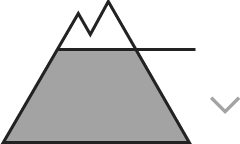
Tendency
The avalanche danger is slowly decreasing.
Danger level
1600m
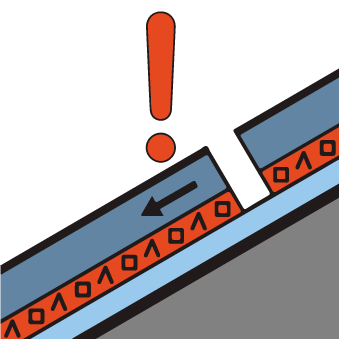
Avalanche Problem
Persistent weak layer
1600m
Obstacles are difficult to recognise.
The avalanche risk is low. Occasional small slab avalanches can be triggered, in particular with large additional loads. Avalanche prone locations are located above around 1600 m on extremely steep shady slopes. The risk of falling and injury is greater than the danger of burial.
Snowpack
Below 1500 metres, the snowpack will be superficially moist. At higher altitudes, a few centimetres of new fallen snow cover a compact old snowpack. This is dominated on the surface by wind and melting snow caps. The snowpack base often consists of angular, gritty snow. Fracture propagation over larger areas is not to be expected with the overall low-stress and low-thickness snowpack. In wind-protected, shady slopes at higher altitudes, there is still well-set powder snow.