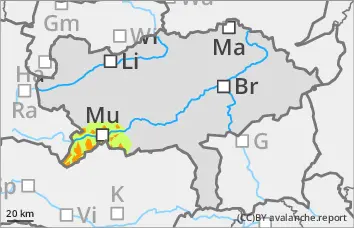
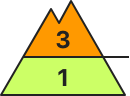
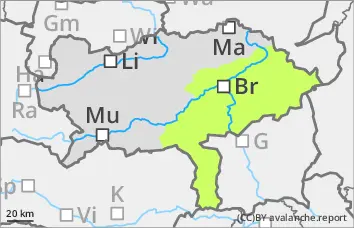
15 to 30 cm of new fallen snow with wind on a weak old snowpack! Tricky situation for winter sports in open terrain!
15 to 30 cm of new fallen snow was deposited on a soft snow surface or surface hoar under moderate to strong winds. Medium-sized slab avalanches can be triggered in some places. Naturally triggered avalanches and remote triggering are also possible. Fractures can tear through the poorly built-up persistent weak layer. The avalanche prone locations are barely recognisable and should be assessed defensively. Take particular care in the transition from a little to a lot of snow and in the blown-in entrance areas of gullies and bowls.
Snowpack
The new fallen snow was deposited on a poorly built-up old snowpack in mostly moderate winds. Due to the weather conditions, a bound layer (board) formed. On the one hand, fractures occur within the old snowpack, which often consists of a sequence of melt-freeze crusts and angular forms or deep rime. On the other hand, existing weak layers can be disturbed at the transition from new fallen snow to old snowpack. Below around 1600 metres, the snowpack is moist.
Tendency
On Friday, there will be a brief intermittent high with some sunny spells. In the afternoon, it will start to get cloudy again from the west.
The avalanche danger decreases slightly.
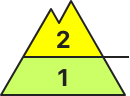
Danger level
treeline
Avalanche Problem
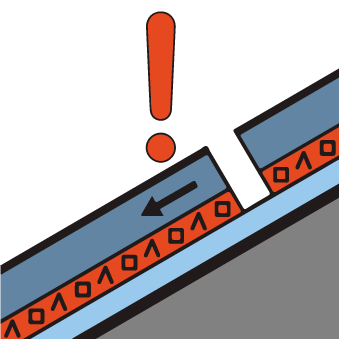
Persistent weak layer
Treeline
Wind slab
Treeline
Persistent weak layer problem in northern and eastern sectors, covered by fresh wind slab! Wind slabs and persistent weak layers are still prone to triggering
The avalanche risk is assessed as moderate above the tree line and low below. There is still a persistent weak layer problem in the northern and eastern exposures. In addition, fresh pillows of wind drifted snow can be triggered as small slab avalanches by low additional loads. Medium-sized slab avalanches are also possible when breaking through the weak old snowpack. The danger areas are mainly located in the transition from little to more snow as well as behind terrain edges and in the entrance area of gullies and bowls. The avalanche prone locations are often difficult to recognise.
Snowpack
Depending on the amount of new snow and the effect of the wind, new and wind slab snow was deposited on a soft snow surface in places and on surface hoar in sheltered locations. The wind slab in particular is still prone to triggering in higher, steeper areas. There is significantly more snow in shady gullies and bowls than on sunny slopes. In the northern and eastern exposures, the old snowpack continues to be weakened by crusts and layers with faceted crystals and floating snow; the persistent weak layer problem remains. There is still significantly less snow than average. Below around 1600 metres, the snowpack is wet.
Tendency
On Friday, there will be a brief intermittent high with some sunny spells. In the afternoon, it will start to get cloudy again from the west.
The avalanche danger decreases slightly.
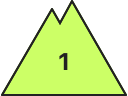
Danger level
treeline
Avalanche Problem
Persistent weak layer
Treeline
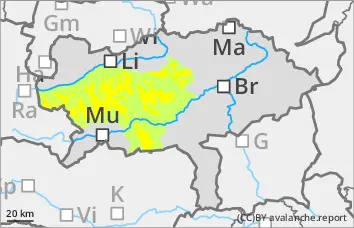
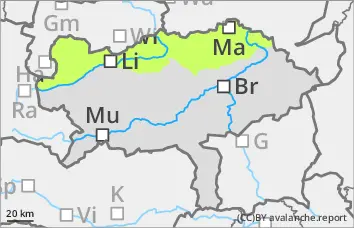
Low avalanche danger with mostly little snow.
The avalanche risk is low. In a few places, especially in locations above the tree line, snowdrift accumulations can be triggered as small slab avalanches in steep gullies and bowls. Avalanche prone locations and icy areas can be covered with a thin layer of fresh snow. Small, wet slides cannot be ruled out at altitudes below 1500 metres.
Snowpack
There is still significantly less snow than average. A thin, partly bound snowpack covers a very variable and mostly hard old snowpack. In shady gullies and bowls, the connection between the bound snowpack and the old snowpack is sometimes poor. In addition, angular shapes can weaken the snow base, fundament.
Tendency
On Sunday, the sun will often shine over the peaks, but in the morning it will still often be cloudy and foggy below 2000 metres.
No change in the avalanche danger is expected.
Danger level
treeline
Avalanche Problem
Persistent weak layer
Treeline
Wind slab
Treeline
Low avalanche danger, but persistent weak layer problems in the northern and eastern exposures!
The avalanche risk is low. In the northern and eastern exposures, there is still a persistent weak layer problem at altitudes above the tree line. In addition, the strong to stormy southerly winds have created fresh pillows of wind drifted snow. In steep terrain, these can be triggered in a few places. However, the avalanches remain small even if they tear through to the old snowpack. In general, the risk of entrainment, falling and injury outweighs the risk of burial. However, be careful in the area of terrain traps.
Snowpack
There is still significantly less snow than average. A thin, partly bound snowpack covers a very variable and mostly hard old snowpack. There is significantly more snow in shady gullies and bowls than on sunny slopes, some of which are partly bare up to 2000 metres. In the northern and eastern exposures, the snowpack is still weakened by layers with faceted crystals and floating snow (persistent weak layer problem!).
Tendency
On Sunday, the sun will often shine over the peaks, but in the morning it will still often be cloudy and foggy below 2000 metres.
The persistent weak layer problem remains.