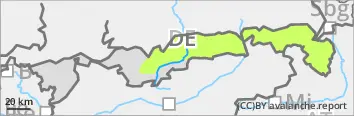
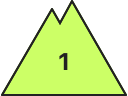
Carefully assess wind slab with increasing height.
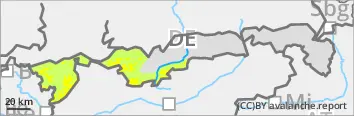
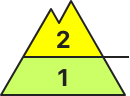
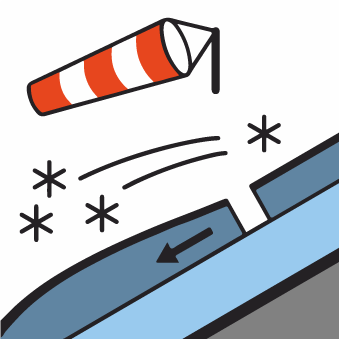
The avalanche risk is moderate above the tree line and low below it. The main problem is wind slab. In steep terrain adjacent to ridgelines as well as in gullies and bowls, slab avalanches can occasionally be triggered by even small additional loads. Slab avalanches can reach medium size.
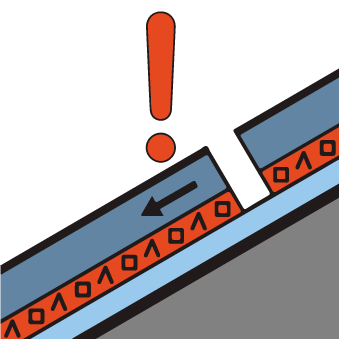
Persistent weak layers can also be problematic above 1400 metres. In a few places, medium slab avalanches can be triggered in deeper layers by large additional loads. These avalanche prone locations are mainly found on shady slopes at the transition from little to much snow.
Snowpack
On a small scale, windslab snow lies partly on soft snow at high altitudes, otherwise on variously crusted can form snow surfaces. A weak layer of angular snow crystals has formed underneath these layers of harsh snow. In the middle layers, this layer slowly stabilises with mild temperatures and a lack of outgoing longwave radiation. The base of the snowpack often consists of gritty floating snow. There is little to no snow on the south side.
Tendency
Slight increase in avalanche danger with new fallen snow and wind.
Danger level
1400m
Avalanche Problem
Persistent weak layer
1400m
Usually too little snow for ski tours.
The avalanche risk is low. Small avalanches can be triggered, especially with large additional loads. The few avalanche prone locations are found on very steep slopes in the northern and eastern aspects, especially when entering gullies and bowls. Particularly in the Allgäu and in the highest areas of the Berchtesgaden Alps also in the area of small-scale wind slab.
Snowpack
On the surface there are a few centimetres of dry, partly bonded snow on a melt-freeze crust. The old snowpack usually has an angular structure and is interspersed with more or less massive surface crusts. Crack propagation over larger areas is not to be expected. Overall, there is little snow.
Tendency
Slight increase in avalanche danger with new fallen snow and wind.