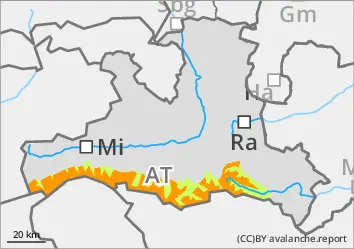
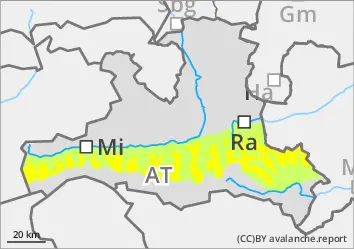
Danger areas in the wind slab next to the blown-off areas
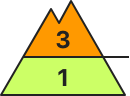
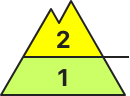
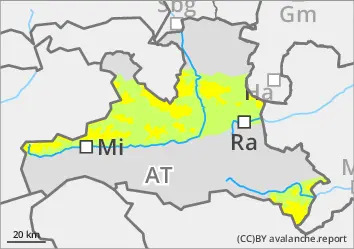
The avalanche danger is considerable above 2000 m and low below.
Slab avalanches can be triggered in some places by small additional loads (individual winter sports enthusiasts) and can reach medium size. Avalanche prone locations are located in particular in the north-west, north to south-east facing steep terrain, adjacent to the ridgeline and area distant from ridgelines, behind terrain edges as well as in gullies and bowls. They increase rapidly in size and frequency with altitude from the tree line upwards. Wind slabs often lie directly next to blown-off areas, are easily recognisable and should be avoided at all costs. Cracks and whumpfing collapsing sounds when walking on the snow cover, snowpack are a sign of danger.
Snowpack
Under the influence of mild air and sunlight, the snow cover, snowpack has settled and become cardboardy up to around 2000 metres. It has at least a thin melt-freeze crust in the morning. Moderate southerly foehn forms fresh, initially still thin wind slab, which is likely to be susceptible to disturbance on the often still soft old snow base leeward. Further weak layers of faceted crystals and deep rime lie in the persistent weak layer below and can be activated occasionally by surface avalanches. The total snow depth is still well below average in many places. Broad ridge and ridges are often completely blown off.
Tendency
The southerly wind will pick up to 60 km/h on Saturday and will cause an increasing wind slab problem on the northern sides.
Danger level
1800m
Avalanche Problem
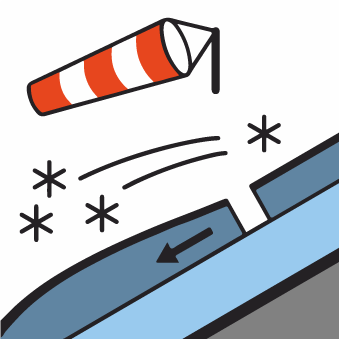
Wind slab
1800m
The wind slab is easily recognisable - avoid it consistently
The avalanche danger is moderate above around 1800 metres and low below.
Small to medium slab avalanches can still be triggered in very steep terrain by low additional loads. Most avalanche prone locations are on north-west, north to south-east facing slopes, behind ridges and in gullies and bowls. The wind slab is easily recognisable and should be avoided. Cracks and whumpfing collapsing sounds when walking on the snow cover, snowpack indicate danger.
Snowpack
Under the influence of mild air and sunlight, the snow cover, snowpack has settled and become cardboardy up to around 2000 metres. It has at least a thin melt-freeze crust in the morning. At higher altitudes, the wind slab from the weekend is still prone to triggering in places. The transition to the old snowpack (faceted crystals on/under the crust) usually serves as a weak layer. It consists of layers of faceted crystals, deep rime and melt-freeze crusts. Surface-triggered avalanches can tear through to the ground. The total snow depth is still well below average. Ridges and ridges are often completely blown off.
Tendency
The southerly foehn will pick up a little on Saturday. Depending on the wind influence, increase in avalanche prone locations due to fresh wind slab.
Danger level
2000m
Avalanche Problem
Wind slab
2000m
Avoid easily recognisable wind slabs
The avalanche danger is moderate above 2000 metres and low below. Small to medium slab avalanches can still be triggered in very steep terrain by low additional loads. Most avalanche prone locations are on north-west, north to south-east facing slopes, behind ridges and in gullies and bowls. The wind slab is easily recognisable and should be avoided. Cracks and whumpfing collapsing sounds when walking on the snow cover, snowpack indicate danger.
Snowpack
Under the influence of mild air and sunlight, the snow cover, snowpack has settled and become cardboardy up to around 2000 metres. It has at least a thin melt-freeze crust in the morning. At higher altitudes, the wind slab from the weekend is still prone to triggering in places. The transition to the old snowpack (faceted crystals on/under the crust) usually serves as a weak layer. It consists of layers of faceted crystals, deep rime and melt-freeze crusts. Surface-triggered avalanches can tear through to the ground. The total snow depth is still well below average. Ridges and ridges are often completely blown off.
Tendency
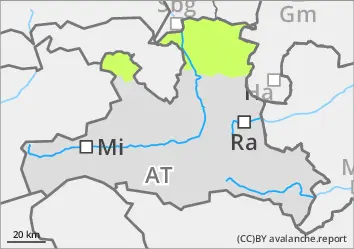
Little change in most of the region. Only in the Tennengebirge and on the Gosaukamm can a revival of the southerly foehn create fresh wind slabs and increase the avalanche prone locations.
Danger level
Avalanche Problem
Wet snow
Low risk of small, wet avalanches
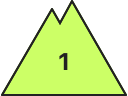
The avalanche risk is low. Individual wet and predominantly small avalanches can spontaneously break loose from very steep terrain with the sunlight.
Snowpack
The snow cover, snowpack is moist to wet due to rainfall, mild air and sunlight, depending on the altitudes, and closes with a crust of melt or rain ice, which can rise during the day. The snow base, fundament is partially weakened by persistent weak layers.