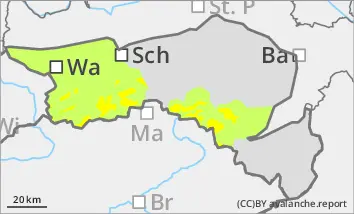
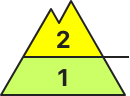
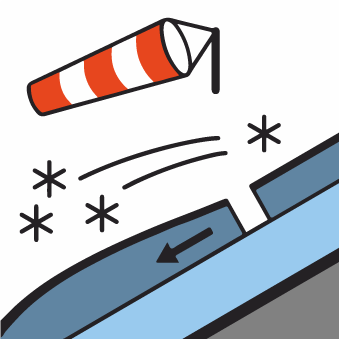
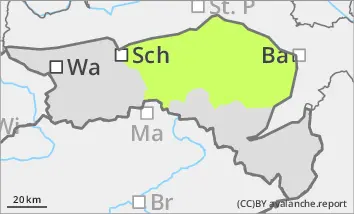
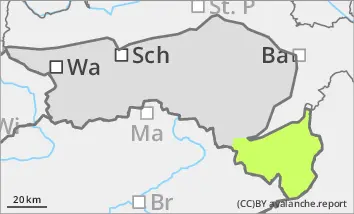
Snowdrift accumulations are prone to triggering in places, note the occasional wet slide
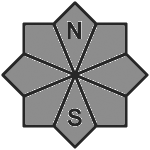
The avalanche danger is moderate at higher altitudes. In a few places, drifting snow areas can be triggered by a single person as small slab avalanches. The avalanche prone locations are located in particular in the steep terrain adjacent to the ridgeline, crest or summit with aspects from northwest to east to south as well as in gullies and bowls. The risk of being swept away and falling is greater than the risk of burial.
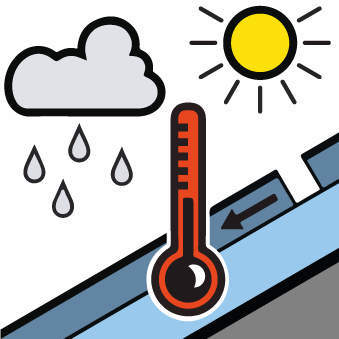
In addition, small, spontaneous loose snow slides are possible from extremely steep slope areas with increasing moistening of the snow cover, snowpack and warming.
Snowpack
Wind slabs deposited on a soft layer of snow interspersed with graupel are occasionally prone to triggering. Weak layers for slab avalanches are formed by soft layers of snow (new fallen snow, faceted crystals) in the transition to the crusted can form. The snow cover, snowpack loses firmness with rainfall and warming. In general, the amount of snow is still well below average.
Tendency
Increasing high pressure will ensure several stable, dry days. A westerly high-altitude current will continue to bring in mild air at high altitudes and it will often remain frost-free throughout in the low mountain regions. The risk of drifting snow decreases.
Danger level
Note isolated snowdrift accumulations and wet slide
The avalanche danger is low. Nevertheless, there are isolated snowdrift accumulations behind exposed ridges and ridgelines as well as in gullies and bowls that are triggered as small slab avalanches. The risk of falling outweighs the risk of burial.
In addition, small, spontaneous loose snow slides are possible from extremely steep slope areas as the snow cover becomes wetter and warms up.
Snowpack
At higher altitudes, snowdrift accumulations lie sporadically on soft layers of snow, which can act as a weak layer. The snow cover, snowpack loses firmness with rainfall and warming. In general, the amount of snow is still well below average.
Tendency
Increasing high pressure will ensure several stable, dry days. A westerly high-altitude current will continue to bring in mild air at high altitudes and it will often remain frost-free throughout in the low mountain regions. The risk of drifting snow decreases.
Danger level
treeline
Avalanche Problem
Wind slab
Treeline
Snowdrift accumulations are prone to triggering in places, note the occasional wet slide
The avalanche danger is low. Nevertheless, drift snow areas can be triggered by a single person as small slab avalanches in a few places. The avalanche prone locations are located in particular in the steep terrain adjacent to the ridgeline, crest or summit with aspects from north-west to east to south as well as in gullies and bowls. The risk of being swept away and falling is greater than the risk of burial.
In addition, small, spontaneous loose snow slides are possible from extremely steep slope areas with increasing moistening of the snow cover, snowpack and warming.
Snowpack
Wind slabs deposited on a soft layer of snow interspersed with graupel are occasionally prone to triggering. Weak layers for slab avalanches are formed by soft layers of snow (new fallen snow, faceted crystals) in the transition to the crusted can form. The snow cover, snowpack loses firmness with rainfall and warming. In general, the amount of snow is still well below average.
Tendency
Increasing high pressure will ensure several stable, dry days. A westerly high-altitude current will continue to bring in mild air at high altitudes and it will often remain frost-free throughout in the low mountain regions. The risk of drifting snow decreases.