Slow increase in avalanche danger due to fresh wind slab!
The avalanche danger increases to moderate in the morning hours above the tree line. Fresh snowdrift accumulations in the north, east and south sectors, mainly behind terrain edges and in gullies and bowls, can sometimes be triggered as small to medium slab avalanches due to low additional loads. In addition to the risk of burial in terrain traps, the risk of being swept away and falling must also be taken into account.
Snowpack
Fresh and older snowdrift accumulations often lie on faceted crystals or surface hoar, which can act as a weak layer. Under a few centimetres of new fallen snow, the snow cover, snowpack on sunny slopes is hard or icy. In general, kinetic metamorphism weakens the thin snow base, fundament. Windward terrain is usually blown off and almost snow-free.
Tendency
Friday will be milder for a short time and some new fallen snow is still to be expected. The risk of avalanches will increase slightly. From today's perspective, it may snow again and again at the weekend.
Danger level
treeline
Avalanche Problem
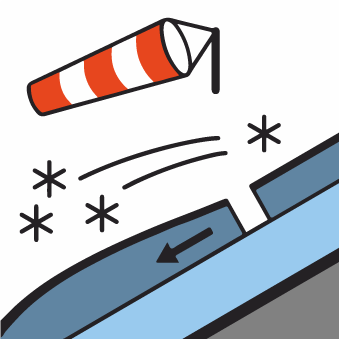
Wind slab
Treeline
More amount of new snow with wind.
The new light snow has not adhered well to the old snow base. With moderate to strong north-easterly winds, numerous patches formed. Above the forest line in the Snežnik area, a snow avalanche can be triggered with even a small load. Spontaneous avalanches are also possible.
Snowpack
dp.6: cold, loose snow and wind
Up to 50 cm of dry and light snow has fallen in recent days.
At the same time, moderate to strong winds have been blowing, carrying the snow and creating drifts and drifts. The snowpack is markedly uneven. There is a lot of blowing snow, especially on the leeward slopes.
Tendency
The cold weather will not change the situation much.
Danger level
treeline
Avalanche Problem
Wind slab
Treeline
Slab avalanches usually remain small.
The avalanche risk is moderate above the tree line and low below it. Wind slabs can be triggered in all aspects by a small additional load, usually in the form of a small slab. The risk of being swept away and falling is generally greater than the danger of being buried.
Snowpack
Stormy winds create small, fresh snowdrift accumulations that come to rest unfavourably on a soft, soft old snow surface, sometimes also on fresh surface hoar, in areas where the wind is calm. Older snowdrift accumulations lie on old surface hoar in some places. Below a melt-freeze crust close to the surface, faceted crystals can be found at higher altitudes right down to the ground. There is little snow on the south side.
Tendency
With stormy winds and new fallen snow, the avalanche risk increases slightly.
Danger level
treeline
Avalanche Problem
Wind slab
Treeline
Persistent weak layer
2000m
Places with blowing snow are more dangerous
Places with blowing snow are particularly dangerous, as even a small load can trigger a small to medium-sized avalanche. Places where fresh snow has fallen on hard and icy ground are particularly dangerous.
Snowpack
dp.6: cold, loose snow and wind
A total of 10 to 20 cm of light, dry snow has fallen in recent days, carried by a strong northeasterly wind on exposed slopes. New fallen snow has fallen on hard and icy ground and is therefore quite unstable. Particularly in places with blown snow, there is a greater danger of triggering an avalanche of packed snow.
Tendency
The cold will not change the situation much. In the high alpine regions, the wind will still carry light snow.
Danger level
treeline
Avalanche Problem
Wind slab
Treeline
Slab avalanches can reach medium size.
The avalanche risk is moderate above the tree line and low below it. Wind slab can be triggered as a small or medium slab avalanche by a small additional load. Avalanche prone locations can be found in all aspects of the steep terrain adjacent to the ridgeline, as well as in gullies and bowls. In addition to the risk of burial, the risk of being swept away and falling must be taken into account.
Snowpack
With stormy westerly winds, fresh snowdrift accumulations develop, which come to rest unfavourably on a soft, soft old snow surface, sometimes also on fresh surface hoar in wind-calm areas. Older wind slabs are sometimes still prone to triggering on old surface hoar. Below a melt-freeze crust close to the surface, faceted crystals can often be found right down to the ground, especially at higher altitudes. There is little snow on the south side.
Tendency
With stormy winds and new fallen snow, the avalanche risk increases slightly.
Danger level
2000m
Avalanche Problem
Wind slab
2000m
Increasing avalanche danger during the day due to some fresh snow and wind
Freshly generated snowdrifts are prone to triggering. Danger zones are located especially near ridgelines on shady W-N-SE facing slopes and in wind-loaded gullies and bowls. Frequency and spread of avalanche prone locations increase with ascending altitude and as the day proceeds. In addition, isolated avalanches can be releases in high alpine regions on very steep shady slopes in the weak old snow. Apart from the risks of being buried in snow masses, the danger of being swept along and being forced to take a fall also require caution.
Snowpack
Fresh snowfall is anticipated: 5-15cm. This and the loosely-packed old snow will be transported by the intermittently strong-velocity winds. Fresh snow and drifts will be deposited frequently on top of a loosely-packed old snowpack surface and bond poorly with it. The old snowpack is unfavorably metamorphosed. On shady slopes in high alpine regions, isolated weak layers occur inside the old snowpack.
Tendency
Avalanche danger will continue to increase as result of fresh snowfall and wind
Danger level
2000m
Avalanche Problem
Wind slab
2000m
Some new fallen snow and wind form fresh wind slabs
The avalanche danger is moderate above 2000 metres and low below.
Small snow slabs can be triggered by individual winter sports enthusiasts in some places, adjacent to the ridgeline and distant from ridgelines behind terrain edges in north-west, east and south-facing terrain. Fresh, prone-to-triggering wind slabs can also accumulate in gullies and bowls. In addition to the risk of burial, attention must be paid to the risk of being swept away and falling. There are also still many rocks lurking.
Snowpack
Wind and some snowfall form fresh, brittle wind slab snow (Brett), which comes to rest on the last new/wild snow (from 3/4 January) (= weak layer, or edged crystals directly on the last melt-freeze crust).
The old snowpack consists of layers of faceted crystals, deep rime and melt-freeze crusts and has little tendency to break up.
The amount of snow is well below average.
Tendency
There will also be fresh wind slab on Friday.
Danger level
treeline
Avalanche Problem
Wind slab
Treeline
Snowdrift accumulations are still susceptible to faults!
The avalanche danger is low. However, the older snowdrift accumulations at higher altitudes are still prone to triggering. At the same time, the strong north-westerly wind is creating new snowdrift accumulations during the day. The avalanche prone locations are located in particular in the steep terrain adjacent to the ridgeline, crest or summit as well as in gullies and bowls. In places, they can be triggered as a small snow slab by even a small additional load. With limited visibility, the avalanche prone locations are difficult to recognise due to the wind slab. The risk of being swept away and falling is greater than the risk of burial.
Snowpack
The snow cover, snowpack is very variable and has been strongly influenced by the wind in recent weeks. Hardness, blown-off areas alternate with older and fresh snowdrift accumulations in a confined space. The snow cover is often interspersed with graupel. Weak layers can be found especially at the transition to the crusted old snowpack. The snow depth remains well below average. The few centimetres of new fallen snow on Thursday will be blown away by strong to stormy winds.
Tendency
On Friday, a warm front will temporarily make it a little milder and a few centimetres of new fallen snow will be added. On Sunday, a new cold front could bring more new fallen snow. The wind will continue to be strong to stormy.
No significant change in the avalanche situation is expected on Friday. An increase in avalanche danger is possible at the weekend.
Danger level
treeline
Avalanche Problem
Wind slab
Treeline
Low avalanche danger, but watch out for fresh wind slab!
The avalanche danger is low. However, fresh and older snowdrift accumulations in snow-covered gullies and bowls as well as behind broad ridges and ridgelines above the tree line are prone to triggering. In a few places, the wind slab can be triggered by individuals as a small slab avalanche. In addition to the rather low risk of burial in terrain traps, the risk of being swept away and falling must also be taken into account.
Snowpack
Fresh and older snowdrift accumulations often lie on faceted crystals or surface hoar, which can act as a weak layer. Apart from this, the snow surface is only slightly covered by new fallen snow and is hard or icy on the sunny slopes below. In general, kinetic metamorphism weakens the thin snow base, fundament. Windward terrain is usually blown off and almost snow-free.
Tendency
Friday will be milder for a short time and some new fallen snow is still to be expected. The risk of avalanches will increase slightly. From today's perspective, it may snow again and again at the weekend.
Danger level
Low avalanche danger
The avalanche danger is low, isolated danger areas due to fresh snowdrift accumulations can be found behind the edges of the terrain adjacent to the ridgeline, crest or summit.
Snowpack
Little snow. There is often only a few centimetres of soft snow or wind slab on the meadows or on a thin crust of harsh snow.
Tendency
No change in avalanche danger.
Danger level
Avalanche Problem
Wind slab
More amount of new snow with wind.
The new light snow has not adhered well to the old snow base. In moderate to strong north-easterly winds, slush is forming.
Snowpack
dp.6: cold, loose snow and wind
Up to 50 cm of dry and light snow has fallen in recent days.
At the same time, there has been a moderate wind, which has carried the snow and built up drifts and drifts. The snowpack is markedly uneven. There is a lot of blowing snow, especially on the leeward slopes.
Tendency
The cold weather will not change the situation much.
Danger level
Avalanche Problem
Wind slab
Slightly increasing avalanche danger
Avalanche danger will increase slightly during the course of the day. Freshly generated, mostly small-sized snowdrift accumulations can be triggered as small slab avalanches in places. Danger zones are located especially near ridgelines and in wind-loaded gullies and bowls, as well as in extremely steep terrain. Apart from the risks of being buried in snow masses, the danger of being swept along and being forced to take a fall also require caution.
Snowpack
Fresh snowfall is anticipated: 5-15cm. This and the loosely-packed old snow will be transported by the intermittently strong-velocity winds. Fresh snow and drifts will be deposited frequently on top of a loosely-packed old snowpack surface and bond poorly with it. The old snowpack is unfavorably metamorphosed.
Tendency
Avalanche danger will continue to increase as result of fresh snowfall and wind
Danger level
treeline
Avalanche Problem
Wind slab
Treeline
Isolated snowdrift accumulations still prone to triggering!
The avalanche danger is low. However, small snowdrift accumulations in gullies and bowls and behind broad ridges and ridgelines above the tree line are still prone to triggering. In a few places, the wind slab can be triggered by individuals as a small slab avalanche. However, the avalanche prone locations are easily recognisable. In addition to the rather low risk of burial in terrain traps, the risk of being swept away and falling must also be taken into account.
Snowpack
Isolated snowdrift accumulations often lie on faceted crystals or surface hoar, which can act as a weak layer. Apart from this, the snow surface is hard or icy on sunny slopes. In shady terrain, the surface is often soft. In general, kinetic metamorphism weakens the thin snow base, fundament. Windward terrain is usually blown off and almost snow-free.
Tendency
Friday will be milder for a short time and some new fallen snow is expected. The risk of avalanches will increase slightly. From today's perspective, it may snow again and again at the weekend.
Danger level
2000m
Avalanche Problem
Wind slab
2000m
Few avalanche prone locations at higher altitudes!
The avalanche danger is predominantly low. Attention should be paid to steep slopes in areas adjacent to the ridgeline as well as steep backfilled bowls and gullies. Here, only small slab avalanches could be triggered in a few places by low additional loads. Avalanche prone locations are easy to recognise and should be avoided.
Snowpack
Due to the cold temperatures, older snowdrift accumulations are still present at high altitudes. These can contain thin intermediate layers and often lie on angular forms or on a superficially hard old snowpack. There are only a few centimetres of new fallen snow, which is being transported somewhat in the higher elevations by strong west to north-westerly winds. The thin snow base, fundament is weakened by the kinetic metamorphism. The snow depths are very below average, even at high altitudes.
Tendency
No significant change. Attention should be paid to small, localised fresh loads high up in the Alps.
Danger level
2000m
Avalanche Problem
Wind slab
2000m
Fresh snowdrifts and stones are the main danger.
The avalanche risk is low.
At high altitudes, fresh drift snow and small snow slabs in gullies and bowls adjacent to the ridgeline can be triggered by individual winter sports enthusiasts. Most of the avalanche prone locations are in the north and east sectors. The risk of falling outweighs the risk of burial away from terrain traps and there is usually more danger from stones than from snow.
Snowpack
Wind and a little snowfall form fresh wind slab, which comes to rest on the soft snow from 3/4 January or a crust.
The old snowpack consists of layers of faceted crystals, deep rime and melt-freeze crusts and has little tendency to break up.
Overall, there is little snow.