Beware of prone to triggering snowdrift accumulations
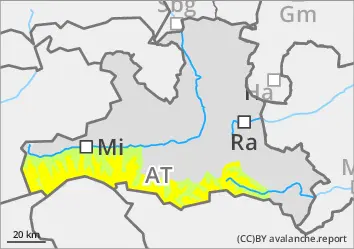
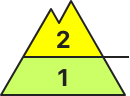
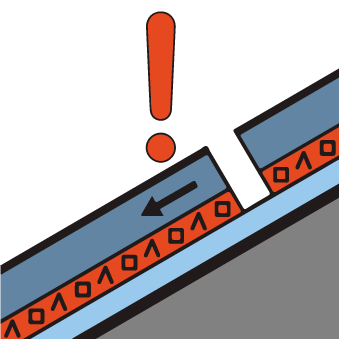
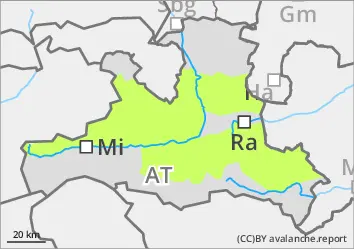
The avalanche danger is moderate above 2200 m and low below. Above around 2200 m, snow slabs can be triggered in some places by slight additional load in the wind slab and occasionally become medium sized. Danger areas due to wind slabs increase with altitude and are located adjacent to the ridgeline, but also distant from ridgelines behind terrain edges and in gullies and bowls. In some cases, they are covered by a few centimetres of soft new fallen snow and are not clearly visible. In shady slopes at high altitudes, there are also isolated trigger points for small to medium-sized slab avalanches in persistent weak layers that are difficult to disturb.
Snowpack
The snow cover, snowpack is highly variable and below average. Fresh and older, brittle wind slab snow lies on a crusted can form surface. In some places, the wind slab is covered by a few centimetres of very soft new fallen snow. Weak layers are most likely to be found in the wind slab and at the transition to the melt-freeze crust. Below this are layers of faceted crystals and melt-freeze crusts. Due to the heavily built-up transformed snow cover, the fracture propagation potential is generally low. In isolated places, however, a prone-to-triggering combination of weak layer and snow slab cannot be ruled out, especially on the shady slope.
Tendency
It remains cold, the new and wind slab snow is slow to settle.
Danger level
2200m
Avalanche Problem
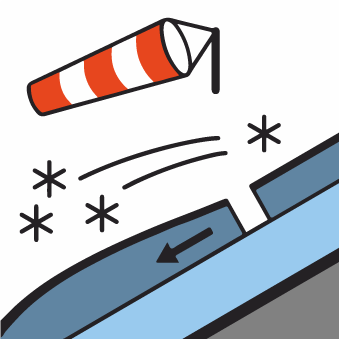
Wind slab
2200m
Wind slabs and stones are the main danger.
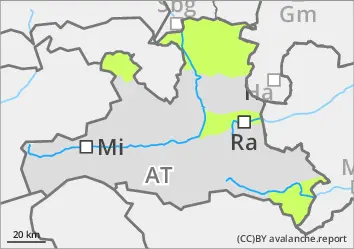
The avalanche danger is low. Above 2200 m, small snow slabs in the wind slab can still be triggered in a few places by a small additional load. Be careful in the area of terrain traps, where enough snow could accumulate to bury people. Drift snow packs are most likely to accumulate behind terrain edges adjacent to the ridgeline and in gullies and bowls. They are sometimes covered by a little soft new fallen snow and are therefore not always easily recognisable. Beware of stones under the thin snow cover, snowpack.
Snowpack
The snow cover, snowpack is highly variable. Fresh and older wind slab snow lies adjacent to the ridgeline on a crusted can form surface. In some places, the wind slab is covered by a few centimetres of very soft new fallen snow. Weak layers are most likely to be found in the wind slab and at the transition to the melt-freeze crust. Below this are layers of faceted crystals and melt-freeze crusts. However, due to the heavily built-up transformed snow cover, the potential for fracture propagation is generally low. On the sunny slopes, the snow cover, snowpack is hard and crusted can form, or the subsoil is only thinly covered. The snow depth is still well below average at all altitudes.
Tendency
It remains cold, the new and wind slab snow is slow to settle.
Danger level
Low avalanche danger, watch out for small snowdrift accumulations
The avalanche risk is low, isolated danger areas due to older snowdrift accumulations are located behind edges of the terrain adjacent to the ridgeline and in gullies and bowls that have been blown in. The drift snow packs are usually easily recognisable, but danger areas due to stones under the thin snow cover, snowpack are often not.
Snowpack
There is a below-average amount of snow and the snow cover, snowpack is highly variable. In shady slopes at high altitudes, there are isolated weak layers of faceted crystals in the snow cover, mostly in the vicinity of crusts. Away from this, there is a succession of thin layers of drifting snow on the meadows.