There are hardly any avalanches possible in the foothills.
The avalanche risk is low. At high altitudes, small slab avalanches with a high additional load can be triggered in shady, extremely steep terrain.
Snowpack
At night, the snow surface cools and freezes. It softens again quickly during the day. In shady locations, it usually remains hardness throughout the day. At higher altitudes (above around 1500 metres), faceted crystals have formed close to the surface below the melt-freeze crust. Otherwise, the snow cover, snowpack is compact and stable. There is little snow. The southern sides are becoming increasingly snow-free up to high altitudes.
Tendency
The amount of new snow remains low and the avalanche risk unchanged.
Danger level
Injury from stones and falling are the main dangers.
The avalanche danger is low. Only very rarely can drift snow packs be triggered by individuals in shady slopes, avalanches remain small. In areas adjacent to the ridgeline, crest or summit, there are very occasional trigger points for small avalanches that are difficult to disturb, even in persistent weak layers.
Snowpack
The snow depth is well below average for the time of year, low to medium elevations and the sunny slopes are widely covered in snow. The snow cover, snowpack is moistened during the daytime changes on the sunny slopes and often remains frozen in the shade. At high altitudes on the shady slopes, weak layers of faceted crystals are occasionally preserved in the snow cover, mostly in the vicinity of crusts.
Tendency
The avalanche danger remains low, even if it snows a little on Wednesday.
Danger level
Not much snow. Low avalanche danger.
Isolated avalanches can be triggered in extremely steep terrain. Most releases are small. Risks of falls and injuries outweigh those of being buried in snow masses.
Snowpack
The crust that forms at night - breakable-to-capable of bearing loads - softens up during the daytime on sunny slopes, remains hard-frozen on the surface in shady terrain. South-facing slopes are already bare of snow up to high altitudes. Little information is currently available to the Avalanche Warning Service from outlying terrain.
Tendency
No significant change anticipated
Danger level
The tour options are generally very limited!
Only at very high altitudes is there occasional problematic persistent weak layer in shady, very steep extreme terrain.
Snowpack
Even at higher altitudes there is very little snow, below that it is often bare or there is no closed snow cover, snowpack. Where there is snow, it softens a little on sunny slopes during the day, otherwise it is hard-frozen or icy in places.
Tendency
No change. No new fallen snow is expected in the coming days either, except for Wednesday (forecast up to 5cm of new snow).
Danger level
2600m
Avalanche Problem
Persistent weak layer
2600m
Rare avalanche prone locations in persistent weak layers of snow
The avalanche danger is low. Small avalanches in particular can occasionally be triggered by one person in shady slope high alpine regions above 2600 metres. This is where the older and fresh foehn drift snow has formed a suitable shelf above a weak layer (usually in persistent weak layer). In addition to the risk of burial, the risk of falling and injury should be taken into account.
Snowpack
On the sunny slope, the snow cover, snowpack is moistened during the daytime changes. On the shady slope, it often remains hard-frozen on the surface, below which there is partly unbound edged snow at altitude, which can serve as a weak layer in exceptional cases, but usually does not tend to propagate fractures. This is above the hardness of the old snow from early winter or crusts in the snow cover, snowpack. The snow depth is well below average at all altitudes.
Tendency
The avalanche danger remains low, even if it snows a little on Wednesday.
Danger level
Avalanche Problem
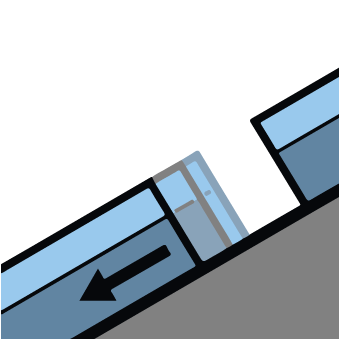
Gliding snow
Low avalanche danger! Hardness of the old snowpack!
The avalanche danger between the Totes Gebirge and the Schladminger Tauern is rated as low. Isolated avalanche prone locations can be found in the extremely steep gullies above 2400m in the northern sector. The danger of falling is more dominant than the danger of avalanches!
Snowpack
The snowpack surface is usually hard and icy. Below the melting hard crust, the kinetic metamorphism weakens the snow layering on the northern sides. On the sunny slopes, the slopes are bare up to over 2000 metres. There is generally little snow in Styria.
Tendency
The avalanche danger will increase slightly in the southern mountain groups on 24.12.2.
Only a little new fallen snow is expected north of the Mur-Mürzfurche, so the avalanche danger will not increase.
Danger level
Lack of snow and stones are the main dangers.
The avalanche risk is low. There is usually not enough snow for snow sports and avalanches can hardly be triggered.
Snowpack
There is no closed snow cover, snowpack and the terrain is mostly bare.
Tendency
The avalanche danger remains low, even if it snows a little on Wednesday.
Danger level
2000m
Avalanche Problem
Persistent weak layer
2000m
The danger of Avalanche is low.
Snowpack is mostly stable. In arid areas above the snow line, weak layers may be present in the snowpack. In a few places in the high alpine regions, a small, clustered Avalanche may be triggered under higher loads.
Snowpack
dp.4: cold following warm / warm following cold
Snow is scarce. There is a crust on top, which has been building up over the last few days. There is some new snow on the old snow base at an altitude of 2000 m above sea level. Peaks and ridges may be blown. On the sunny slope, there are already significant areas of land outside the High alpine regions. In the high alpine regions, weak layers may be present in the Old snow cover.
Tendency
Wednesday will also be cloudy and foggy with moderate NE winds. Around 10 cm of New fallen snow will fall. It will be colder than Tuesday. On Thursday, light snow will continue with a stronger NE wind, and the High alpine regions may reach above cloudy. The danger of avalanches will increase slightly due to the new blowing snow.
Danger level
2400m
Avalanche Problem
Persistent weak layer
2400m
Isolated avalanche prone locations in persistent weak layer of old snow.
In isolated cases avalanches can be triggered in persistent weak layers on very steep shady slopes. These releases are mostly small-sized. In addition, generally small-sized snowdrift accumulations have been generated at very high altitudes. The risks of falling and sustaining injuries outweigh those of being buried in snow masses.
Snowpack
The snowpack crust - breakable to capable-of-bearing-loads – which is generated during the nocturnal hours softens up during the daytime on sunny slopes, on shady slopes the snowpack surface often remains hard-frozen. Since there is hardly any transportable snow, strong-velocity southerly winds generated only small-sized local snowdrift accumulations. On shady slopes in high alpine regions, isolated weak layers occur inside the snowpack. South-facing slopes are bare of snow up to high altitudes. Only limited information is currently available to the Avalanche Warning Services from outlying terrain.