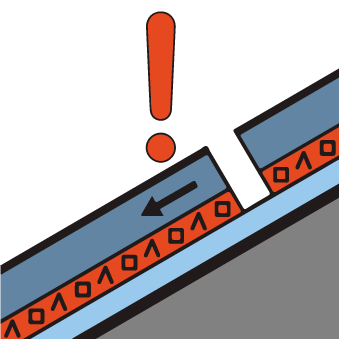
Isolated avalanche prone locations in persistent weak layer of old snow.
In isolated cases avalanches can be triggered from persistent weak layers on very steep shady slopes. These releases are mostly small-sized. The risks of falling and sustaining injuries outweigh those of being buried in snow masses.
Snowpack
The crusts which were generated overnight - breakable to capable-of-bearing-loads - soften up during the course of the day on sunny slopes, on shady slopes often remain frozen hard. The shallow snowpack is generally well consolidated and low in tensions. On shady slopes in high alpine regions, isolated weak layers still occur inside the snowpack. South-facing slopes are bare of snow up to high altitudes. Since there is only little transportable snow, increasing southerly winds in the foehn-exposed mountain regions can generate only small snowdrift accumulations. Only little information is currently available to the Avalanche Warning Service from outlying terrain.
Tendency
Avalanche danger expected to remain low
Danger level
Lack of snow and stones are the main dangers.
The avalanche danger is low. There is usually not enough snow for snow sports and avalanches can hardly be triggered.
Snowpack
There is no closed snow cover, snowpack and the terrain is mostly bare.
Tendency
The avalanche danger remains low.
Danger level
2000m
Avalanche Problem
Persistent weak layer
2000m
The danger of avalanches is low.
The snowpack is mostly stable. In arid areas above the forest line, weak layers may be present in the snowpack. In a few places in the high alpine regions, a small, clustered Avalanche may be triggered under higher loads.
Snowpack
dp.4: cold following warm / warm following cold
There is little snow, with a crust on top. There is some new snow on the old snow base at altitudes of 2000 m. Peaks and ridges may be blown. On the Sunny slope, there are already significant areas of land outside High alpine regions. In the high alpine regions, weak layers may be present in the old snow cover.
Tendency
Snow conditions are not expected to change significantly in the coming days. The Crust will strengthen overnight and soften during the day on the Sunny slope. Sunday will be fairly clear in the mountains, remaining relatively warm for this time of year. Monday will see some more clouds, with light southerly winds. Temperatures will be around 0 °C at 1500 m and -3 °C at 2500 m.
Danger level
2600m
Avalanche Problem
Persistent weak layer
2600m
Rare avalanche prone locations in persistent weak layers of snow
The avalanche danger is low. Small avalanches in particular can occasionally be triggered by one person in shady slope high alpine regions above 2600 metres. This is where the older and fresh foehn drift snow has formed a suitable shelf above a weak layer (usually in persistent weak layer). In addition to the risk of burial, the risk of falling and injury should be taken into account.
Snowpack
On the sunny slopes, the snow cover, snowpack is soaked up to high altitudes during the daytime changes. On the shady slope, it often remains hard-frozen on the surface, below which there is partly unbound edged snow at altitude, which can serve as a weak layer in exceptional cases. This is the case, for example, above the hard old snow from early winter. The snow depth is well below average at all altitudes.
Tendency
The avalanche danger remains low.
Danger level
Injury from stones and falling are the main dangers.
The avalanche danger is low. Only very rarely can drift snow packs be triggered by individuals in shady slopes, avalanches remain small. In areas adjacent to the ridgeline, crests or summits, there are isolated trigger points for mainly small avalanches that are difficult to disturb, even in persistent weak layers.
Snowpack
The snow depth is well below average for the time of year, low to medium elevations and the sunny slopes are widely covered in snow. The snow cover, snowpack is soaked up to high altitudes on the sunny slopes during daytime changes and often remains frozen hard in the shade. At high altitudes on the shady slopes, weak layers of faceted crystals still remain in the snow cover, mostly in the vicinity of crusts.
Tendency
The avalanche danger remains low.
Danger level
The avalanche danger is mainly concentrated in the shady terrain at high altitudes.
The avalanche risk is low. Persistent weak layers can be problematic. There are individual avalanche prone locations on extremely steep slopes in northern aspects above 2200 metres. Small slab avalanches can occasionally be triggered there with large additional loads.
Snowpack
The snow surface has crusted can form in many places. It softens again during the daytime changes. On the shady slopes, it usually remains hard and icy. In shady slopes at higher elevations, weak layers can be found in the snow cover, snowpack. Otherwise, the snow cover, snowpack is compact and stable. There is little snow, on the south side the ground is covered up to high altitudes.