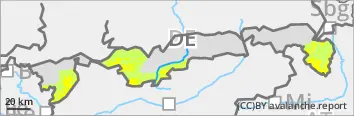
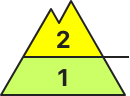
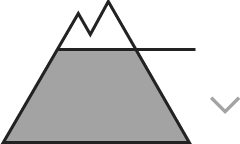
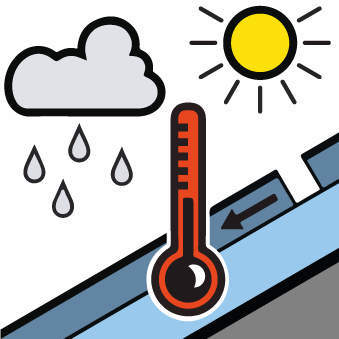
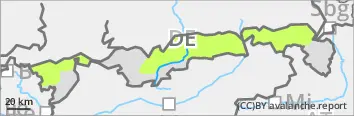
The avalanche risk is moderate above 1500 metres and low below that. Wet snow is problematic. Wet loose snow and slab avalanches are to be expected, especially at high altitudes where there is still a lot of snow. In extremely steep terrain in all aspects of the slope, they detach themselves; on very steep slopes, they can be triggered by individuals. On steep slopes with smooth ground, such as on meadow slopes, in patchy mountain forests or on smooth rock slabs, wet gliding avalanches occur. Avalanches reach medium size.
Snowpack
The snowpack is soaked up to high altitudes. At higher altitudes, there are a few centimetres of soft, moist snow on a largely stable and, on shady slopes in particular, still thick old snowpack. In places, layers of faceted crystals have been preserved deeper in the snowpack at high altitudes exposed to the north. On the south side, the ground is already bare again above the tree line.
Tendency
Little change.
Danger level
Avalanche Problem
Wet snow
Increasing snow cover also on the north side
The avalanche risk is low. Wet snow is problematic. In extremely steep terrain, loose snow avalanches can occasionally come loose. Wet gliding avalanches can occur on steep slopes with smooth ground that have not yet been discharged. Avalanche activity is limited to terrain on shady slopes where there is still snow. Wet avalanches usually remain small.
Snowpack
The remaining snowpack is completely soaked, the meltwater runoff hardly decreases even overnight. The southern sides are largely snowed out.