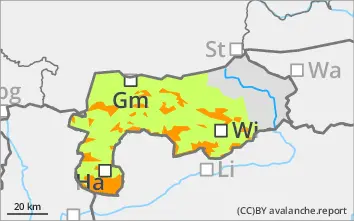
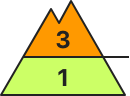
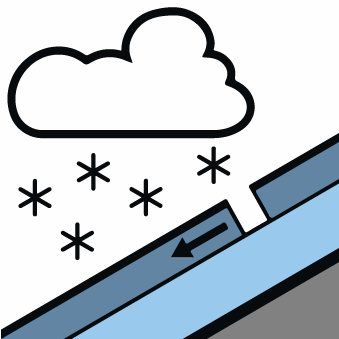
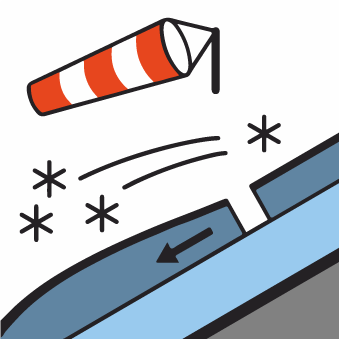
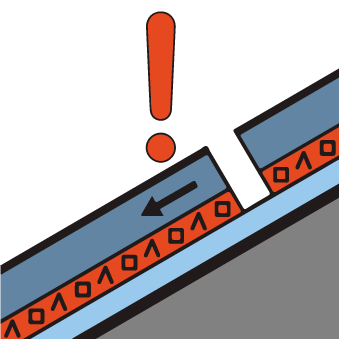
The avalanche risk is considerable above the tree line. The significant wind slab problem must be taken into account. Slab avalanches can be triggered by even a small additional load. There are danger spots in steep terrain adjacent to ridgelines, but also distant from ridgelines, in filled-in bowls and gullies and at terrain transitions. Medium to rarely large avalanches are possible. Spontaneous loose snow avalanches are to be expected, especially from sunny, extreme terrain. Below the tree line, individual gliding avalanches or small, wet loose snow avalanches cannot be ruled out.
Snowpack
During the last snowfall event, there was 40 to 80 cm of new fallen snow, depending on altitude and region. Due to strong to stormy winds, extensive prone to triggering snowdrift accumulations have formed, which can contain weak layers and bond poorly with the old snowpack. Inside, the persistent weak layer is usually compact, but often moist up to high altitudes. The snow base, fundament is high up and partly weakened on shady slopes. In the middle and low altitudes, the last snow often lies on bare ground.