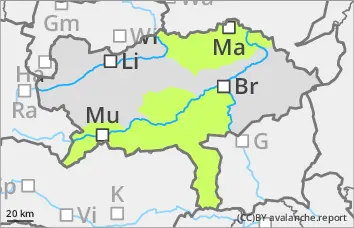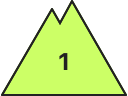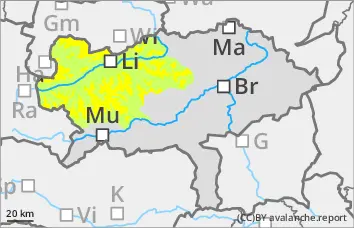
Danger level
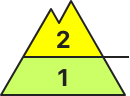 | 2000m |
|  |
|  |

Note the persistent weak layer!
The avalanche risk is moderate above around 2000 metres and low below that. In the aspects from west to north to east, mostly medium-sized, dry slab avalanches can be triggered in the persistent weak layer (near the surface) in a few places above 2000 metres. The avalanche prone locations are very steep, shady areas adjacent to ridgelines, behind terrain edges and in entrances to gullies and bowls. Occasionally they can travel through to layers close to the ground. Take particular care at the transition from a little to a lot of snow, the avalanche prone locations are not recognisable in the terrain. During the daytime changes, small, wet loose snow slides can form on extremely steep, sunny terrain.
Snowpack
In places, there is still older wind slab, which is only prone to triggering in isolated areas. With southerly foehn, thin pillows of wind drifted snow can form at high altitudes. Weak layers in the form of faceted crystals in the area of crusts are present in places in the transition to the persistent weak layer and in the persistent weak layer itself. Close to the ground, floating snow (large cup crystals) still weakens the snowpack in places. Warmth and sunlight lead to the snowpack becoming moist. Deep and sunny middle layers are bare.
Tendency
Onset of winter! With new fallen snow and widespread stormy winds, the avalanche danger increases significantly!