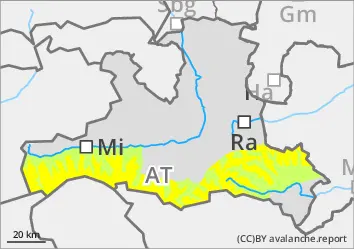
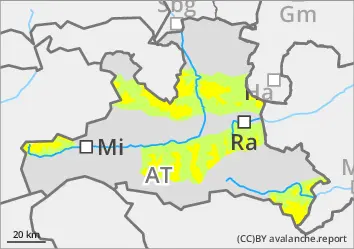
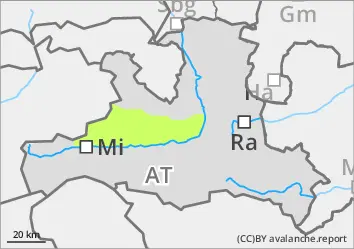
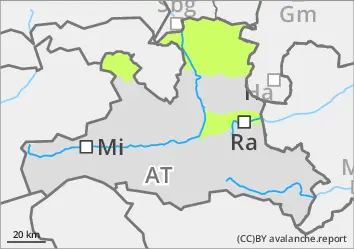
Avalanche prone locations in persistent weak layers are rare but have serious consequences, snowdrift accumulations are prone to triggering at altitude
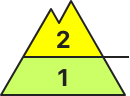
The avalanche risk is moderate above 2000 metres and low below that.
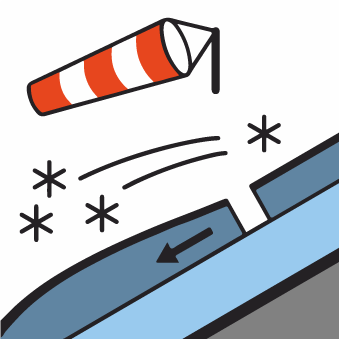
Above 2200 m, avalanches can be triggered by individuals in wind slabs, in particular in aspects from north-west to north to north-east. Danger areas are easily recognisable, they are located behind terrain edges and in steep gullies and bowls. Avalanches can reach medium size and occasionally become large if they tear through the persistent weak layer.
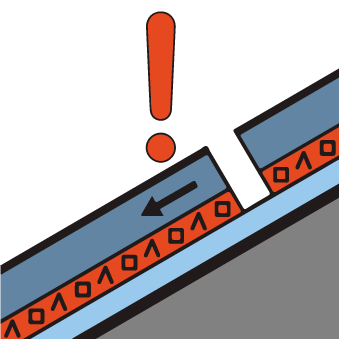
Above 2000 m, in aspects from west to north to east, medium and occasionally large, dry slab avalanches can still be triggered in persistent weak layers in a few places. Although such avalanche prone locations are rare, they are not recognisable in the terrain. Take particular care at the transitions from little to more snow.
Snowpack
Fresh wind slabs can form at high altitudes. Older snowdrift accumulations have often stabilised well up to high altitudes. In places (on shady slopes, in high alpine locations also on sunny slopes), however, they are still prone to triggering. Faceted crystals on a crust serve as a weak layer near the surface below the wind slab. Faceted crystals on crusts can also be found deeper in the snowpack, while the snowpack near the ground consists of angular, cup-shaped crystals. The connection at the transition to the deep snowpack near the ground is still poor. Deep and sunny middle layers are once again bare.
Tendency
Gradual settlement of the snowdrift accumulations.
Danger level
2000m
Avalanche Problem
Persistent weak layer
2000m
Wind slab
2200m
Pay attention to weak persistent layers and wind slabs at altitude
The avalanche risk is moderate above 2000 m and low below. Above 2000 m, medium slab avalanches can be triggered by individuals in a few places in the aspects from west to north to east. Such avalanche prone locations are rare but not recognisable in the terrain. Take particular care at the transitions from little to more snow.
Above 2200 m, avalanches can be triggered by individuals in wind slabs in a few places, in particular in the aspects from north-west to north to north-east. Danger areas are easily recognisable, they are located adjacent to ridgelines behind terrain edges as well as in steep gullies and bowls. Avalanches can occasionally reach medium size.
Snowpack
Fresh wind slabs can form at high altitudes. Older snowdrift accumulations have often stabilised well up to high altitudes. In shady high altitudes, however, they are still prone to triggering. Faceted crystals on a crust serve as a weak layer near the surface below the wind slab. Faceted crystals on crusts can also be found deeper in the snowpack; near the ground, the snowpack consists of angular, cup-shaped crystals. The connection at the transition to the deep snowpack near the ground is still poor. Deep and sunny middle layers are once again bare.
Tendency
Gradual settlement of the snowdrift accumulations. Gradual settlement of the snowdrift accumulations.
Danger level
2000m
Avalanche Problem
Persistent weak layer
2000m
Note the persistent weak layer
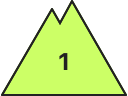
The avalanche risk is low. Above 2000 m, medium slab avalanches can be triggered in a few places in the aspects from west to north to east, in particular due to large additional loads. Such avalanche prone locations are rare but not recognisable in the terrain. Take particular care at the transitions from little to more snow.
In summit locations, avalanches can still be triggered by individuals in wind slabs, in particular in the aspects from north-west to north to north-east. Danger areas are easily recognisable, avalanches remain small. The risk of falling generally outweighs the risk of burial.
Snowpack
Fresh wind slabs may still form at high altitudes. Older snowdrift accumulations have mostly stabilised well up to high altitudes. Occasionally, faceted layers can be found underneath drift snow packs. Faceted crystals can also be found on crusts deeper in the snowpack; near the ground, the snowpack consists of angular, cup-shaped crystals. The connection at the transition to the deep snowpack near the ground is still poor. Deep and sunny middle layers are once again bare.
Tendency
No significant change.
Danger level
Mostly favourable conditions with little snow
The avalanche risk is low. In the entrance areas of steep gullies on shady slopes, snow slabs can occasionally be triggered in persistent weak layers. The risk of being swept away and falling on icy surfaces that may be thinly covered with snow and therefore difficult to recognise generally outweighs the risk of burial.
Snowpack
It is snowing heavily. The new and wind slab snow from the beginning of the week has stabilised well. In the higher, on-shady slopes, there are still weak layers of large faceted crystals in the lower part of the snowpack, especially near the ground. Low and sunny mid-altitude areas are free of snow again.