Small snowdrifts frequently still prone to triggering
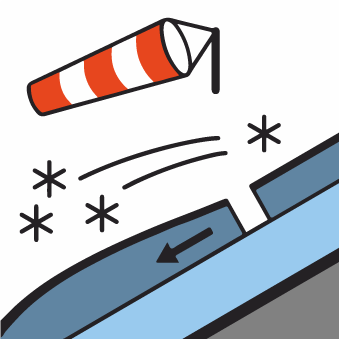
Older snowdrifts are frequently still prone to triggering, can be triggered even by minimum additional loading as small-to-medium sized slab avalanches. Danger zones occur primarily on steep ridgeline north-facing slopes and in wind-loaded gullies and bowls. Frequency and spread of avalanche prone locations increase with ascending altitude. If avalanches on high-altitude shady slopes fracture down to deeper weak layers, they can in isolated cases then grow to medium size. Such avalanche prone locations occur primarily in spots where the snow is shallow or in transitions from shallow to deep snow.
Snowpack
The small-to-medium sized snowdrifts of recent days have increasingly consolidated, especially on sunny slopes. On steep south-facing slopes there is often a melt-freeze crust capable of bearing loads which softens up during daytime hours. The mid-level part of the snowpack consists of well-settled, compact layers widespread which on high-altitude shady slopes cover a poorly structured old snowpack fundament.
Tendency
Avalanche danger is not expected to change significantly.
Danger level
1800m
Avalanche Problem
Persistent weak layer
1800m
Wind slab
Treeline
Moderate avalanche danger at high altitudes!
The avalanche risk is moderate above 2000 metres and low below. Adjacent to ridgelines, behind terrain edges and in entrances to steep gullies and bowls, smaller slab avalanches can sometimes be triggered by individuals. Medium-sized avalanches are also possible in the northern sector.
Snowpack
The snow base, fundament is largely stable. Only in shady high areas does floating snow still weaken the snow layering. Older wind slabs can be found on the surface in places.
Tendency
Saturday will bring clouds with some new fallen snow. The avalanche danger will hardly change.
Danger level
2000m
Avalanche Problem
Persistent weak layer
2000m
Wind slab
2200m
Avalanche prone locations in persistent weak layers are rare but have serious consequences
The avalanche risk is moderate above 2000 metres and low below that. Above 2000 m, in the aspects from west to north to east, medium and occasionally large slab avalanches can be triggered by individuals in a few places. Such avalanche prone locations are rare but not recognisable in the terrain. Take particular care at the transitions from little to more snow.
Above 2200 m, avalanches can still be triggered by individuals in wind slabs in a few places, in particular in the aspects from north-west to north to north-east. Danger areas are located behind terrain edges and in steep gullies and bowls. Avalanches can occasionally reach medium size.
Snowpack
It is snowing unproductively. New and wind slab snow have mostly stabilised well. Only in shady high altitudes is wind slab snow lying on soft, faceted snow in places. Deeper in the snowpack, faceted crystals can be found on crusts; close to the ground, the snowpack consists of angular, cup-shaped crystals. The connection at the transition to the deep snow near the ground is still poor. Deep and sunny middle layers are once again bare.
Tendency
Gradual settlement of the snowdrift accumulations. Gradual settlement of the snowdrift accumulations.
Danger level
2000m
Avalanche Problem
Persistent weak layer
2000m
Wind slab
2200m
Pay attention to the few avalanche prone locations.
The avalanche risk is moderate above 2000 metres and low below. Persistent weak layers are the main problem. The few avalanche prone locations are mainly in the area of older drift snow accumulations in the steep terrain adjacent to ridgelines with aspects from west to north to east. Take care when entering gullies and bowls. Slab avalanches can be triggered with little additional load. Avalanches usually remain small, but can occasionally penetrate to deep layers and reach medium size.
Smaller gliding avalanches are possible on smooth, steep meadow slopes or rock slabs.
Snowpack
On shady slopes at higher altitudes, soft snow layers can be found close to the surface, some of which are interspersed with a thin surface crust. In places, the layers are overlaid with older wind slab snow. Otherwise, the wind slab is well connected to the old snow surface, which has crusted can form. On shady slopes at higher altitudes, weak layers of faceted crystals can be found deep in the compact old snowpack in some places. If there is sufficient outgoing longwave radiation, a stable melt-freeze crust can form on the south side overnight. On the northern sides of the higher elevations, the snow is still powdery on the surface. Overall, there is little snow.
Tendency
The avalanche danger hardly changes.
Danger level
treeline
Avalanche Problem
Wind slab
Treeline
Persistent weak layer
2000m
Watch out for wind slab above the tree line in steep terrain!
The avalanche risk is moderate at higher altitudes, partly above the tree line. In the steep terrain of the high altitudes, especially adjacent to ridgelines, behind terrain edges and in steep bowls and gullies, snowdrift accumulations can still be triggered as small to rarely medium slab avalanches, in some cases by low additional loads. In the steep terrain on shady slopes, slab avalanches could still be triggered locally due to the problem of old snow.
Snowpack
Above the tree line, especially at higher altitudes, there are still snowdrift accumulations that could still be disturbed. The snow layer on the old snowpack has already settled a little. The snowpack is mostly stable, up to high altitudes in the centre it is partly wet. At higher elevations and on shady slopes, the snow base, fundament is partly weakened.
Tendency
No significant change.
Danger level
2000m
Avalanche Problem
Persistent weak layer
2000m
Wind slab
2200m
Avalanche prone locations in persistent weak layers are rare but have serious consequences, snowdrift accumulations are still accessible at altitude
The avalanche risk is moderate above 2000 metres and low below that.
Above 2000 m, medium and occasionally large, dry slab avalanches can still be triggered in persistent weak layers in the aspects from west to north to east. Although such avalanche prone locations are rare, they are not recognisable in the terrain. Be especially careful at the transitions from little to more snow.
Avalanches in wind slabs can still be triggered by individuals above 2200 m, in particular in aspects from north-west to north to north-east. Danger areas are located behind terrain edges and in steep gullies and bowls. Avalanches can reach medium size and occasionally become large if they tear through the persistent weak layer.
Snowpack
It is snowing heavily. New and wind slab snow from the beginning of the week has often stabilised well up to high altitudes. In places (on shady slopes, in high alpine locations also on sunny slopes) there is wind slab on soft, faceted snow. Deeper in the snowpack, faceted crystals can be found on crusts; close to the ground, the snowpack consists of angular, cup-shaped crystals. The connection at the transition to the deep snow near the ground is still poor. Deep and sunny middle layers are once again bare.
Tendency
Gradual settlement of the snowdrift accumulations.
Danger level
1600m
Avalanche Problem
Wind slab
1600m
Persistent weak layer
1800m
Freshly blown snow
Snowfall in the mountains has ranged from 5 to 15 cm in recent days, with slightly more in the Kamnik-Savinja Alps and the Karavanke Mountains. At the same time, a strong north-easterly wind is blowing, carrying fresh snow and building up new snow layers in the south and west. The new fallen snow is less able to adhere to the older snow base. The danger is higher especially on slopes and in gullies where the height of the New fallen snow is greater due to the snow layers.
In addition to new fallen snow, weak layers in the snowpack deeper in the snowpack are a problem. These weak layers are more numerous in the axis above the forest. In particular, a large avalanche can be triggered if the load exceeds the load-bearing capacity of these layers.
Snowpack
dp.6: cold, loose snow and wind
As the weather cooled, the older snow base froze. Dry and light snow has fallen on harder ground and is now carried by the wind. During the snowfall, the local fall of graupel may also have provided a new weak layer. The snow will have already become somewhat thinner on sunny slopes due to the influence of the sun.
In the old snow cover, the layers of snow are mostly well connected, with a Crust on top, which mostly supports the skier's weight. Deep below the surface, there are several weak layers of faceted snow crystals and sheared grains.
Tendency
Sunday will be mainly cloudy, with light showers possible at first. It will remain relatively cool and windy. The danger of avalanches will remain similar.
Danger level
Favourable avalanche situation
The avalanche risk is low. Wind slabs can be problematic. On the northern sides of the highest summits and areas adjacent to the ridgeline, small slab avalanches with low additional load can be triggered in isolated cases.
Individual, small gliding avalanches are possible on smooth, steep meadow slopes.
Snowpack
Older wind slab snow has usually bonded well with the old snow surface. In the highest areas adjacent to the ridgeline, crest or summit, it can still be prone to triggering on shady slopes. The snowpack is generally well stabilised and slightly moist. If there is sufficient outgoing longwave radiation, a stable melt-freeze crust can form on the south side overnight. The snow is still powdery on the surface only on the steep northern sides of the higher elevations. Overall, there is little snow.
Tendency
The avalanche danger does not change.
Danger level
Mostly favourable conditions with little snow
The avalanche risk is low. In the entrance areas of steep gullies on shady slopes, snow slabs can occasionally be triggered in persistent weak layers. The risk of being swept away and falling on icy surfaces that may be thinly covered with snow and therefore difficult to recognise generally outweighs the risk of burial.
Snowpack
It is snowing heavily. The new and wind slab snow from the beginning of the week has stabilised well. In the higher, on-shady slopes, there are still weak layers of large faceted crystals in the lower part of the snowpack, especially near the ground. Low and sunny mid-altitude areas are free of snow again.
Tendency
No significant change in avalanche danger.
Danger level
treeline
Avalanche Problem
Wind slab
Treeline
Beware of fresh wind slab, watch out for persistent weak layer problems in shady high altitudes.
The avalanche risk is still low.
Avalanche prone locations are mainly limited to fresh snowdrift accumulations in gullies and bowls as well as in steep terrain adjacent to ridgelines. These are small in scale and irregularly distributed due to the changing wind. They can be triggered as small slab avalanches by individual winter sports enthusiasts.
In addition, the persistent weak layer problem must still be taken into account in shady high altitudes. Weak layers in the lower snow layering can be prone to triggering locally.
Snowpack
The snowpack is mostly stable. There is a well-developed melt-freeze crust on which the fresh snow has deposited as wind slab. Due to wind transport, compact drift snow packs have formed locally, which are prone to triggering on a small scale.
In shady high altitudes, large, faceted crystals are still present in the persistent weak layer in places, weakening the foundation of the snowpack.
Below around 1400 m, and on south-facing slopes below around 1600 m, there is only a little snow.
Tendency
The avalanche danger remains the same. Clouds and fog with some new fallen snow on Saturday. Sunday will be friendlier.
Danger level
Avalanche Problem
Wind slab
Beware small snowdrifts
Avalanche danger is generally low. Caution is urged towards older snowdrift accumulations particularly at high altitudes in ridgeline terrain on north-facing slopes and in wind-loaded gullies and bowls. In addition. isolated avalanches can be triggered by large additional loading in extremely steep terrain. Apart from the risks of being buried in snow masses, the danger of being swept along and forced to take a fall require attentiveness.
Snowpack
The fresh small snowdrifts generated over the last few days have bonded well with the old snowpack surface. On steep shady slopes, bonding is often only moderate. On steep south-facing slopes there is often a melt-freeze crust capable of bearing loads. The old snowpack is generally well-settled and compact.
Tendency
Avalanche danger is not expected to change significantly.
Danger level
treeline
Avalanche Problem
Wind slab
Treeline
Pay attention to local avalanche prone locations in exposed terrain!
The avalanche risk is mostly low. Nevertheless, there are a few avalanche prone locations due to wind slabs. Occasionally, slab avalanches can be triggered in the ridgeline and summit area, behind terrain edges and in steep bowls and gullies, sometimes even with a small additional load. The persistent weak layer problem can only occur very rarely on shady slopes and high up in extreme terrain.
Snowpack
Above the tree line, there are still snowdrift accumulations in places that could be disturbed. The snow layer on the snow base, fundament has already settled. The old snowpack is mostly stable, up to high altitudes in the centre it is partly moist. The snow base, fundament is occasionally weakened.
Tendency
Despite some new fallen snow, the avalanche situation hardly changes.
Danger level
treeline
Avalanche Problem
Wind slab
Treeline
Persistent weak layer
2000m
Low avalanche danger, but individual avalanche prone locations due to wind slab!
The avalanche risk is generally low. Nevertheless, there are individual avalanche prone locations, in particular adjacent to ridgelines, behind terrain edges and in entrances to steep, shady gullies and bowls where medium-sized slab avalanches can be triggered by individuals.
Snowpack
The snow base, fundament is largely stable. On the surface, there is older wind slab in places, which is usually well bonded to the snow base, fundament. Only in shady high altitudes does floating snow weaken the snow layering.
Tendency
Saturday will bring clouds with some new fallen snow. The avalanche danger will hardly change.