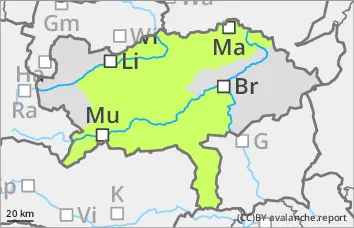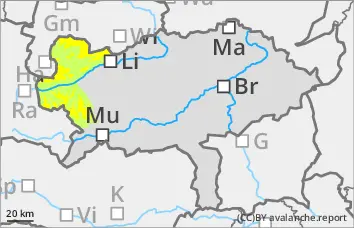
Danger level
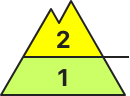 | 1800m |
|  |
|  |
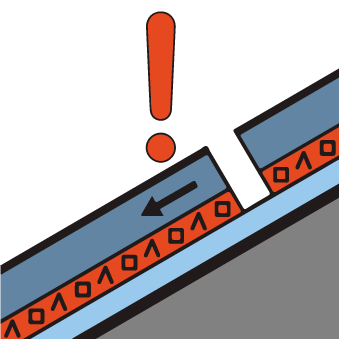

Weak persistent layer is a persistent weak layer
The avalanche risk is moderate above 1800 metres and low below. There is still a persistent weak layer problem in the extended northern sector. Medium-sized slab avalanches can still be triggered by people in steep gullies and bowls. The avalanche prone locations are usually difficult to recognise and are often located in transition areas from little to much snow. The probability of triggering wet snow avalanches increases slightly during the daytime changes from very steep east- to south- to west-facing slopes. In steep terrain, there is a risk of falling on the hard snow surface.
Snowpack
Outgoing longwave radiation is somewhat reduced from the second half of the night. As a result, the snow surface can often only consolidate weakly and soften increasingly on the sunny slopes depending on the incoming radiation. On shady slopes, there are still areas with a soft (faceted) snow surface at higher altitudes, where the firmness of the layer changes depending on the altitude and exposure. Below this there is an increasingly sufficiently settled and compact snowpack, the transition to the foundation consisting of deep rime (floating snow) is still poor. Medium (sunny slopes) and low altitudes are largely free of snow.
Tendency
Quite sunny and dry on Friday and Saturday. With a wind shift to the south-west, it will be partly foehn. Little change in avalanche danger.