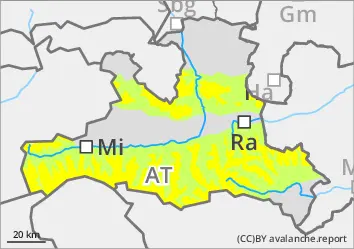
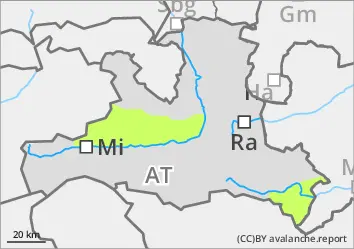
Few avalanche prone locations with high consequences
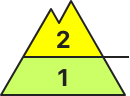
The avalanche risk is moderate above around 2000 metres and low below. In a few places, especially in the aspects from west to north to east, medium, occasionally still large, dry slab avalanches can be triggered by individuals. Danger areas are difficult to recognise. Take particular care at the transitions from little to more snow.
Occasional wet snow avalanches triggered by people on the sunny slopes with soaking of the snowpack are possible. The likelihood of gliding avalanches is slightly increased.
Snowpack
The snowpack outgoing longwave radiation is greatly reduced overnight and only just a thin melt-freeze crust forms. In shady high altitudes, soft, faceted snow can often still be found on the surface. Below this lies a well-set sequence of compact drift snow layers, in which a crust in combination with faceted crystals is usually still embedded. The connection at the transition to the old snow foundation, which consists mainly of deep rime, is still poor. Deep and sunny middle layers are largely snowed out.
Tendency
No significant change in the avalanche danger as the weather improves on Friday.
Danger level
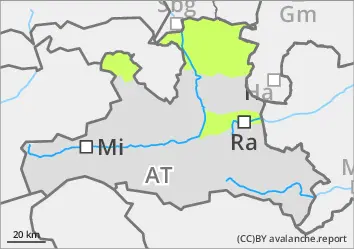
Low risk of isolated wet snow avalanches
The avalanche risk is low. Occasional small wet snow avalanches are possible on the few sunny slopes that have not yet been discharged.
In addition, small snow slabs can still be triggered in exceptional cases in the entrance areas of steep gullies on shady slopes with large additional loads. The risk of being swept away and falling on icy surfaces generally outweighs the risk of burial.
Snowpack
Low and sunny mid-altitude areas are snowed out. Where present, the snowpack is moist to wet and well settled right up to the summit areas. The snowpack outgoing longwave radiation is greatly reduced overnight and only just a thin melt-freeze crust forms. In the higher areas on shady slopes, there are still weak layers of large faceted crystals in the lower part of the snowpack, especially near the ground.
Tendency
No significant change in the avalanche danger as the weather improves on Friday.
Danger level
1800m
Avalanche Problem
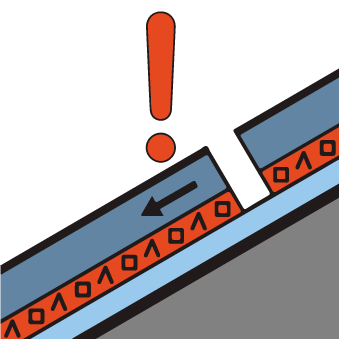
Persistent weak layer
1800m
Note the persistent weak layer
The avalanche risk is low. Medium-sized slab avalanches can still be triggered in a few hard-to-recognise places, especially in the extended northern sector above 1800 m, but usually only with a large additional load. This is in particular at the transitions from little to more snow.
On the sunny slopes, isolated wet snow avalanches are possible as the snowpack softens. These usually remain small.
Snowpack
The snowpack outgoing longwave radiation is greatly reduced overnight and only just a thin melt-freeze crust forms. In shady high altitudes, some soft, faceted snow can still be found on the surface, some of which has already crusted can form. Below this lies a mostly well-set sequence of compact drift snow layers, in which, however, a crust in combination with faceted crystals is usually still embedded. The connection at the transition to the old snow foundation, which consists mainly of deep rime, is still poor. Deep and sunny middle layers are largely snowed out.
Tendency
No significant change in the avalanche danger as the weather improves on Friday.