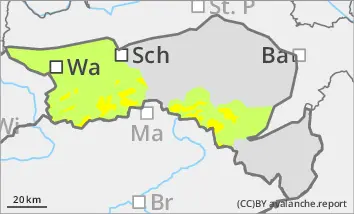
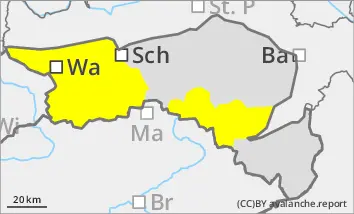
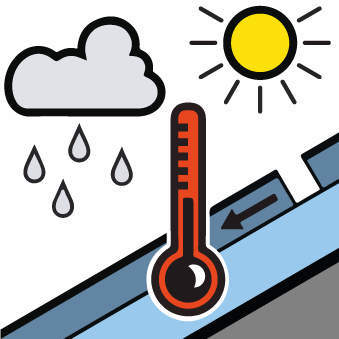
Daily increase in avalanche danger due to wet snow avalanche activity
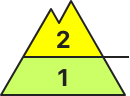
The avalanche risk is moderate above the tree line throughout the day, below it is low until the morning and increases to moderate from late morning as the day warms up and the sun shines. The activity of spontaneous, wet loose snow avalanches increases during the daytime changes. These can detach themselves from very steep rocky and craggy terrain and on very steep forest slopes, especially on sunny slopes, but rarely become medium-sized. Occasionally, small to medium-sized, wet slab avalanches can also be triggered by winter sports enthusiasts on sunny slopes. Above the tree line, small to medium-sized, dry slab avalanches can still be triggered in a few places, especially on shady steep slopes. Gliding avalanches are only possible in isolated cases on snowy steep slopes with a smooth surface (e.g. long grass or foliage). In exposed locations, the snow surface is hard and icy in places and there is a risk of falling.
Snowpack
The snow cover has settled and is less prone to triggering. The snow surface, which is usually only thinly crusted can form due to radiation, is not load-bearing and often softens quickly. Depending on the aspect, the snowpack becomes damp or wet during the day changes up to high altitudes, which leads to decreasing firmness and destabilisation. On steep grass and forest slopes with larger snow reserves, the snowpack can start to glide snow. At shady high altitudes, there are prone to triggering weak layers in the transition to the hardness of the old snowpack. This is unfavourably structured and weakened in places with embedded crusts and faceted crystals.
Tendency
The wet snow problem eases with the influence of the cold front, but the persistent weak layer problem remains in the shady slopes.
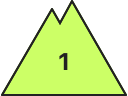
Danger level
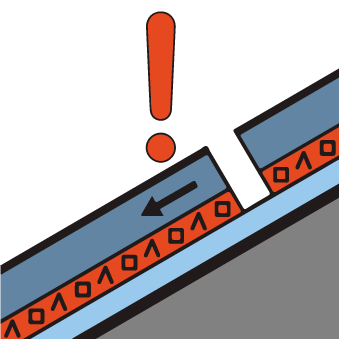
Avalanche Problem
Wet snow
Persistent weak layer
Treeline
Prone to triggering wind slab snow in the higher elevations! Beginning of wet snow problems at lower altitudes.
The avalanche risk is low. Nevertheless, there is a slight increase in small, wet loose snow avalanches during the day, which can spontaneously detach from very steep terrain (e.g. forest embankments). Occasionally, small wet snow slabs can also be triggered by winter sports enthusiasts. In high areas on shady slopes, it is also still possible for winter sports enthusiasts to trigger small to medium-sized, dry slab avalanches, in particular at the entrances to steep gullies and bowls.
Snowpack
The snow cover has already settled. The snow surface, which is usually only thinly crusted due to radiation, is not capable of bearing loads and often softens quickly and, depending on the aspect, becomes damp or wet during the day up to high altitudes, which leads to a decreasing firmness and destabilisation of the snowpack. At shady high altitudes, the old snowpack with crusts and embedded angular crystals is unfavourably structured and weakened in places.
Tendency
The wet snow problem eases with the influence of the cold front, but the persistent weak layer problem remains in the shady slopes.