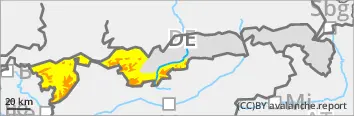
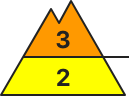
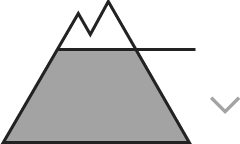
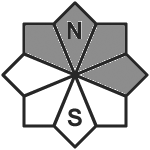
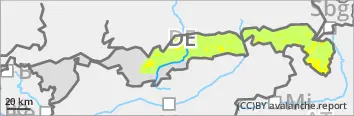
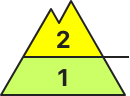
The avalanche risk is considerable above 1600 metres and moderate below that. The main problem at all altitudes is wind slab avalanches. Slab avalanches can easily be triggered by individual winter sports enthusiasts. Avalanche prone locations can be found on steep slopes laden with drifting snow in the north-west, north to south aspects, behind slope discontinuities and in gullies and bowls, as well as in forest aisles and clearings. They increase in number and size with altitude. Avalanches reach medium size.
Above 1800 m, avalanches on very steep shady slopes can also tear through to deeper weak layers in the old snowpack.
Snowpack
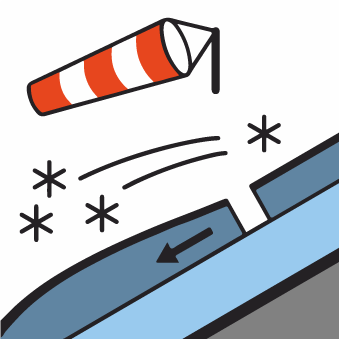
Snow is falling under strong storm conditions from westerly directions and is deposited as wind slab snow on the soft snow surface. Some of the fresh snowdrift accumulations are thick and very prone to triggering. In the upper part of the old snowpack, layers of graupel, surface hoar or thin wind and melt-freeze crusts prone to triggering are embedded in places. Above 1800 m, on shady slopes, there are deeper weak layers of faceted crystals in the snowpack.
Tendency
The avalanche situation will remain tense throughout the week.
Danger level
1600m
Avalanche Problem
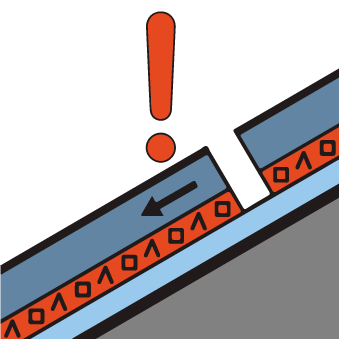
Wind slab
1600m
Wind slab
1600m
Blown-in areas should be avoided.
The avalanche risk is moderate above 1600 metres and low below that. The main problem at all altitudes is wind slab avalanches. Slab avalanches can easily be triggered by individual winter sports enthusiasts. Avalanche prone locations can be found on steep slopes adjacent to ridgelines in the north-west, north to south aspects, behind slope discontinuities and in gullies and bowls, as well as in forest aisles and clearings. Avalanches usually remain small, but if they tear through to deeper weak layers, they can reach medium size.
Snowpack
Accompanied by strong winds from westerly directions, some snow is falling and depositing as wind slab on the soft snow surface. The fresh snowdrift accumulations are very prone to triggering in places. Layers of surface hoar or thin wind and melt-freeze crusts prone to triggering are embedded in the upper part of the old snowpack. On shady slopes, deeper layers of faceted crystals have been preserved in the snowpack in places. Ground contact is to be expected in areas without an old snowpack foundation.
Tendency
Further increase in avalanche danger over the course of the week.