Weak layers in persistent weak layers remain prone to triggering
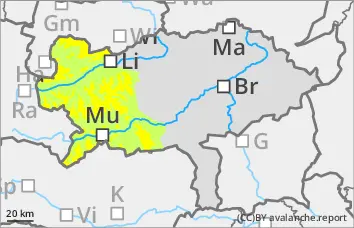
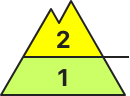
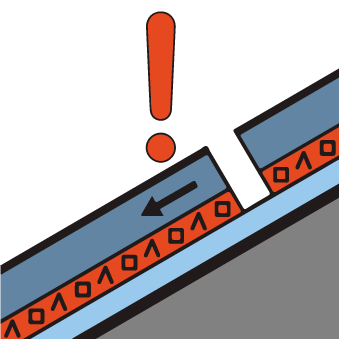
The avalanche risk is moderate above around 1800 metres and low below. There is still a persistent weak layer problem. The avalanche prone locations are limited but still difficult to recognise. These are mainly located on north to east-facing slopes above 1900 metres. Here, slab avalanches can still be triggered by individuals in some places. Medium-sized avalanches are possible when breaking through the weak old snowpack. Small loose snow slides are possible at medium altitudes.
Snowpack
The snow cover is prone to triggering in places in higher, steeper areas in the transition to the old snowpack due to soft layers such as snow-covered surface hoar. There is significantly more snow in shady gullies and bowls than on sunny slopes. In the northern and eastern exposures, the old snowpack continues to be weakened by crusts and layers with faceted crystals and floating snow; the persistent weak layer problem remains. There is still significantly less snow than average.
Tendency
Towards the middle of the week, clouds from a warm front will replace the sunshine and bring local rain or snow showers with a snowfall level of around 1500 metres.
No significant change in the avalanche risk.
Danger level
treeline
Avalanche Problem
Persistent weak layer
Treeline
Low avalanche danger, but persistent weak layer problems in the northern and eastern exposures!
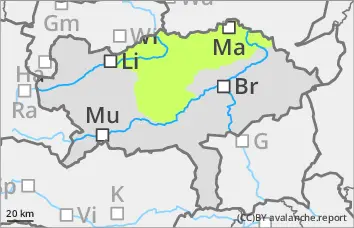
The avalanche risk is low. In the northern and eastern exposures, there is still a persistent weak layer problem at altitudes above the tree line. In steep terrain, avalanches can be triggered in a few places. However, even if the old snowpack is torn through, the avalanches usually remain small. In general, the risk of entrainment, falling and injury outweighs the risk of burial. However, be careful in the area of terrain traps.
Sunny slopes can release wet slides from very steep slopes.
Snowpack
There is still significantly less snow than average. A thin layer partially covers a very variable and mostly hard or crusted can form old snowpack. There is significantly more snow in shady gullies and bowls than on sunny slopes, some of which are partly bare up to 2000 metres. In the northern and eastern exposures, the snowpack continues to be weakened by layers with faceted crystals and floating snow down to the foundations, and the persistent weak layer problem remains.
Tendency
Thick patches of high fog will persist below 2000 metres, particularly on the southern side of the Alps. On the northern side of the Alps, these may clear in foehn-like southerly winds. No significant change in the avalanche danger.
Danger level
Avalanche Problem
Persistent weak layer
Low avalanche danger with mostly little snow.
The avalanche risk is low. Small slab avalanches can be triggered in steep gullies and bowls in isolated places at high altitudes. Avalanche prone locations are covered by a thin layer of snow and are often difficult to recognise. In general, the risk of being swept away, falling and injury outweighs the risk of burial. However, be careful in the area of terrain traps.
Snowpack
There is still little snow. The snowpack is damp or crusted can form in places. In the higher elevations, however, angular snow crystals are still weakening the stability on shady slopes. Above this, in the extended eastern sector, there may also be a thin, bound layer, which in some cases is not well bonded to the old snowpack.
Tendency
Thick patches of high fog will persist below 2000 metres, particularly on the southern side of the Alps. On the northern side of the Alps, these may clear in foehn-like southerly winds. No significant change in the avalanche danger.