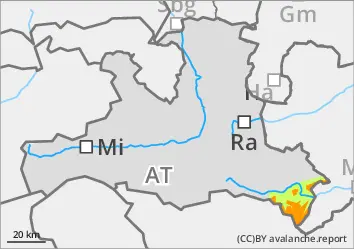
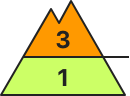
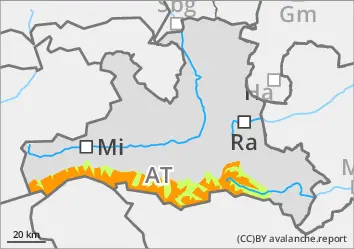
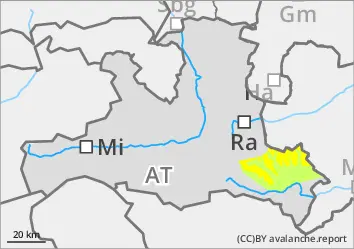
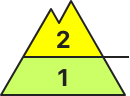
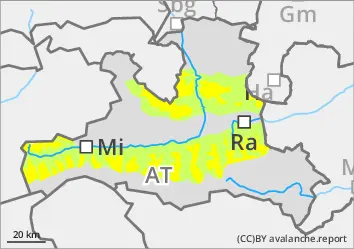
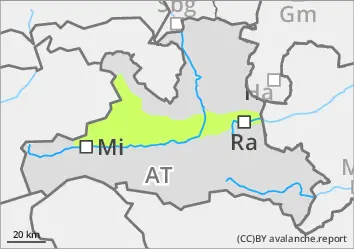
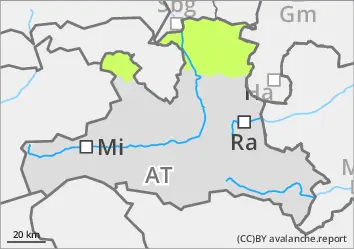
The avalanche risk is considerable above around 1800 metres and low below. The situation is precarious for winter sports. Heat input leads to a better formed slab. Medium-sized slab avalanches can be triggered remotely in some places, especially from west to north to east. This is particularly the case on the borders with neighbouring countries; inland, avalanche prone locations decrease with the amount of fresh snow. Fractures between new and windslab snow can tear through the persistent weak layer and tend to propagate. Avalanche prone locations in the persistent weak layer are barely recognisable and require a defensive choice of route.
Snowpack
Locally there is up to 30 cm of mostly soft new fallen snow on the wind-treated snow surface. Areas with little snow alternate with considerable snowdrift accumulations, some of which are as hard as a board and some of which are already being built up. Breaks usually occur between the fresh and slightly older layers of new or drift snow and near the crust that forms the transition to the completely angular old snowpack. Under this crust, the old snowpack consists mainly of deep rime and angular forms, which are interspersed with other crusts in areas with more snow. On the ground, snow from early winter can sometimes be found in the form of a hard melt-freeze crust.
Tendency
The wind slab problem is slowly improving, but the persistent weak layer problem remains.
Danger level
treeline
Avalanche Problem
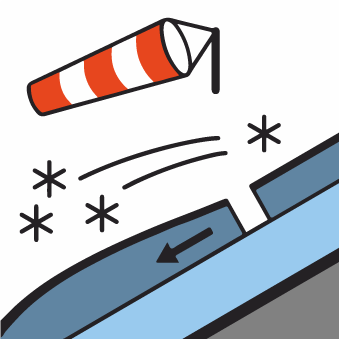
Wind slab
Treeline
Persistent weak layer
2000m
Fresh wind slab forms snow slab on weak old snowpack
The avalanche risk is considerable above the tree line. The situation is precarious for winter sports. Medium-sized slab avalanches can easily be triggered by individuals in some places, especially from west to north to east, but also in a few places in the southern sector. If wind slabs are disturbed near the surface, there is a high likelihood of avalanches breaking through into deeper layers. The old snowpack is poorly built up across the board: Avalanche prone locations are barely recognisable and require a defensive route choice. In particular, be careful near transitions from a little to a lot of snow and in the entrance areas to steep gullies. Remote triggering is possible in isolated cases.
Snowpack
A soft snow surface and surface hoar were overlaid by a strong southerly foehn with fresh wind slab. In the past 24 hours, up to 25 cm of snow fell on top of this again, with less and less wind influence towards the end of the precipitation. In general, areas with little snow alternate with considerable snowdrift accumulations, some of which are as hard as a board and some of which are already building up. Breaks usually occur between the fresh and slightly older layers of drift snow or near the crust that forms the transition to the completely angular old snowpack. Under this crust, the old snowpack consists mainly of deep rime and angular forms, which are interspersed with other crusts in areas with more snow. On the ground, snow from early winter can sometimes be found in the form of a hardness melt-freeze crust.
Tendency
The wind slab problem is slowly improving, but the persistent weak layer problem remains.
Danger level
1800m
Avalanche Problem
Wind slab
1800m
Persistent weak layer
1800m
New and wind slab snow on weak old snowpack
The avalanche risk is moderate above around 1800 metres and low below. The situation is precarious for winter sports. Heat input leads to a better formed snow slab. Medium-sized slab avalanches can be triggered by individuals in some places, especially from west to north to east, but also in a few places in the southern sector. Fractures in the fresh wind slab can tear through the persistent weak layer and tend to propagate. Avalanche-prone locations in the persistent weak layer are barely recognisable and should be assessed defensively. The regions close to the border with fresh snow tend to be more dangerous.
Snowpack
Locally there is up to 20 cm of mostly soft new fallen snow on the wind-treated snow surface. Areas with little snow alternate with considerable snowdrift accumulations, some of which are as hard as a board and some of which are already building up. Breaks usually occur between the fresh and slightly older layers of drift snow or near the crust that forms the transition to the completely angular old snowpack. Under this crust, the old snowpack consists mainly of deep rime and angular forms, which are interspersed with other crusts in areas with more snow. On the ground, snow from early winter can sometimes be found in the form of a hardness melt-freeze crust.
Tendency
The wind slab problem is slowly improving, but the persistent weak layer problem remains.
Danger level
treeline
Avalanche Problem
Wind slab
Treeline
Persistent weak layer
2000m
Fresh, prone to triggering wind slab snow on a weak old snowpack
The avalanche risk is moderate above the tree line and low below. Heat input leads to a better formed slab. Medium-sized slab avalanches can be triggered by individuals in some places, especially from west to north to east, but also in a few places in the southern sector. Fractures in the fresh wind slab can tear through the persistent weak layer and tend to propagate. Avalanche prone locations in the persistent weak layer are barely recognisable and require a defensive choice of route. Take particular care near transitions from a little to a lot of snow and in the blown-in entrance areas to steep gullies.
Snowpack
A few centimetres of mostly transported new fallen snow lies on the wind-treated snow surface. Some of the new snow and wind slabs have been deposited on surface hoar. In general, areas with little snow alternate with considerable snowdrift accumulations, some of which are as hard as a board and some of which are already being transformed. Breaks usually occur close to the crust, which forms the transition to the completely angular old snowpack. Under this crust, the old snowpack consists of deep rime and angular forms, which are interspersed with further crusts in areas with more snow. The overall snow depth is well below average.
Tendency
The wind slab problem is slowly improving, but the persistent weak layer problem remains.
Danger level
2000m
Avalanche Problem
Wind slab
2000m
Persistent weak layer
2200m
Small drift snow accumulations on weak old snowpack
The avalanche risk is low. Above around 2200 m, small slab avalanches can still be triggered by individuals in a few places in the west to north to east sector. Danger areas are located at the transition from little to more snow and generally next to blown-off areas. Some of the avalanche prone locations are difficult to recognise. The risk of falling and injury generally outweighs the risk of burial.
Snowpack
On shady slopes in particular, small snowdrift accumulations overlay a weak old snowpack, which now consists mainly of faceted crystals or deep rime. Otherwise, the surface is partly hard and icy.
Tendency
No significant change in avalanche danger.
Danger level
Low avalanche danger and lack of snow
The avalanche risk is low. There is very little snow, only in the entrance areas to steep, on shady slopes can there be small pillows of wind drifted snow. Otherwise, the danger of injury from stones and falling on icy surfaces outweighs the risk of burial.
Snowpack
The snow surface is easily soaked, on shady slopes it is often hard and icy. Edged persistent weak layers weaken the thin snow base, fundament if present.