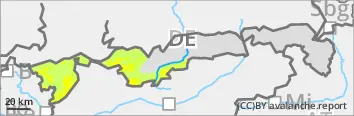
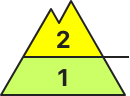
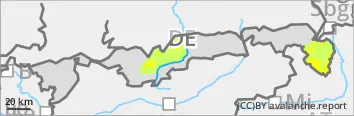
The avalanche risk is considerable above the tree line and low below. The main problem is fresh wind slab. In many places, slab avalanches can be triggered by even a small additional load. Avalanche prone locations are adjacent to ridgelines and distant from ridgelines in steep terrain with aspects from north-west to north to south-east as well as in gullies and bowls. They increase in number and size with altitude. Avalanches can be of medium size - especially if they tear through deeper, weak layers in the persistent weak layer.
Snowpack
With stormy south-westerly winds, fresh snowdrift accumulations develop at altitude. In many places, they come to rest prone to triggering on surface hoar and soft layers. The old snowpack consists of large, angular and rounded crystals and is partly interspersed with melt-freeze crusts. On the sunny slopes, there is little or no snow at all at medium altitudes.
Tendency
With foehn storms, prone to triggering snowdrift accumulations continue to grow, especially at high altitudes.
Danger level
1800m
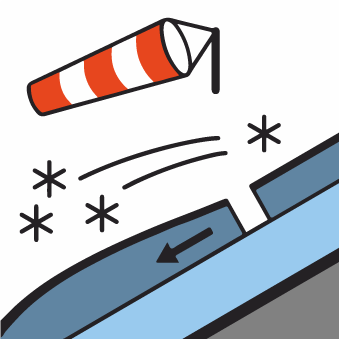
Avalanche Problem
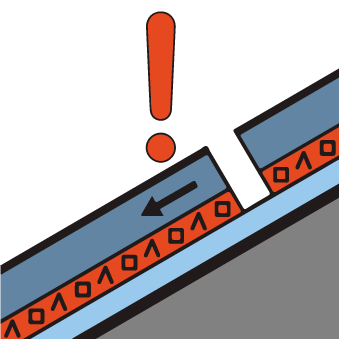
Wind slab
1800m
Persistent weak layer
Some avalanche prone locations in fresh wind slab.
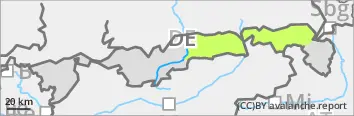
The avalanche risk is moderate above the tree line and low below. The main problem is fresh wind slab. Small slab avalanches can be triggered in some places by even a small additional load. Avalanche prone locations are adjacent to ridgelines and distant from ridgelines in steep terrain with aspects from north-west to north to south-east as well as in gullies and bowls.
Avalanches can occasionally tear through weak layers of persistent weak layer and then become medium sized. In addition to the risk of burial, the risk of falling and injury must be taken into account.
Snowpack
With stormy south-westerly winds, small, fresh snowdrift accumulations develop at altitude. They come to rest prone to triggering on surface hoar and soft layers. The old snowpack consists of large, angular and rounded crystals and is partly interspersed with melt-freeze crusts. There is little or no snow up to high altitudes on the sunny slopes.
Tendency
With foehn storms, prone to triggering snowdrift accumulations continue to grow, especially at high altitudes.
Danger level
Pay attention to small scale wind slab.
The avalanche risk is low. Occasional small slab avalanches can be triggered with little additional load in the wind slab and very occasionally in the persistent weak layer. Avalanche prone locations are adjacent to ridgelines on steep slopes in the northern and eastern aspects. The risk of falling and injury is greater than the danger of burial.
Snowpack
Stormy winds can move the snow where the snow surface is still soft (mostly on the eastern and northern sides) and create small snowdrift accumulations. These are prone to triggering on surface hoar or soft layers. Otherwise, the snow surface is often crusted can form. The melt-freeze crust softens again in the sun. The old snowpack consists of faceted crystals and is partly interspersed with melt-freeze crusts. There is little to no snow on the sunny slopes.