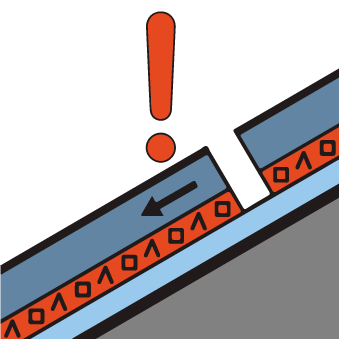
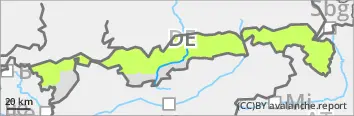
Older wind slab lies on top of a weak persistent weak layer.
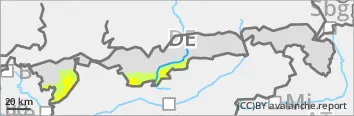
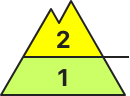
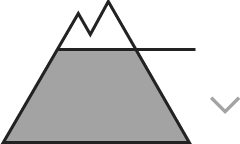
The avalanche risk is moderate above the tree line and low below it. Persistent weak layers are problematic. In some places, old snowdrift accumulations can be triggered as a slab avalanche by even a small additional load in very steep terrain in the north-west to north to south-east aspects. The number and size of avalanche prone locations increase with altitude. Avalanches can reach medium size if deeper, weak layers are also triggered.
Snowpack
Older snowdrift accumulations lie on soft layers or on a melt-freeze crust, under which angular crystals can be found in places. The old snowpack usually consists of faceted crystals with rounded edges and is partly interspersed with melt-freeze crusts. A thin melt-freeze crust forms on the surface on the sunny slopes overnight. Overall, there is little snow.
Tendency
Slight increase in avalanche danger with new fallen snow and wind.
Danger level
Avalanche Problem
Persistent weak layer
Ski touring is hardly possible in the centre and east.
The avalanche risk is low. Persistent weak layers are problematic in some places. Small, old snowdrift accumulations can be triggered as small slab avalanches with a large additional load. The few avalanche prone locations are on very steep slopes in the northern and eastern aspects. The risk of falling and injury is greater than the danger of burial.
Snowpack
Small, old snowdrift accumulations lie on a melt-freeze crust, under which faceted crystals can be found in places. The old snowpack mostly consists of rounded, angular crystals and is partly interspersed with melt-freeze crusts. There is little to no snow at lower altitudes and on the sunny side.
Tendency
Slight increase in avalanche danger with new fallen snow and wind.