Danger level
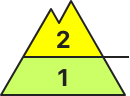 | 1800m |
|  |
|  |
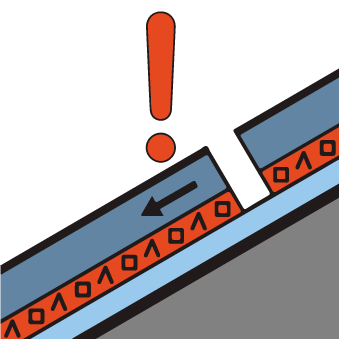

Be aware of persistent weak layer problems due to poor stability!
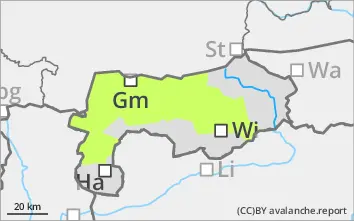
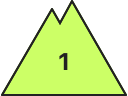
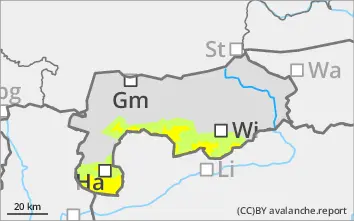
The avalanche risk is still moderate, especially at higher altitudes. There are a few avalanche prone locations in the steep terrain adjacent to ridgelines, at terrain transitions and in steep bowls and gullies, mainly in the northern and eastern sectors of the high altitudes. Triggering of slab avalanches is possible in some places even under slight additional load. In some cases, attention must be paid to small-scale displacements.
Snowpack
Depending on the aspect and hardness of the surface, the snowpack varies in hardness and is partly icy. Despite strong winds, there is hardly any new drifting and, if at all, only traces of new fallen snow. The snowpack contains faceted crystals and/or floating snow, especially in the higher elevations. This means that slab avalanches can easily be triggered here. Mostly at higher altitudes, there may be small-scale, sometimes disturbing drifts. In general, there is very little snow and it is distributed very differently. In addition to completely blown away areas, there are also well-filled areas.
Tendency
No significant changes.