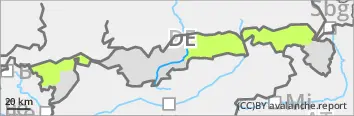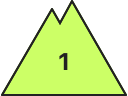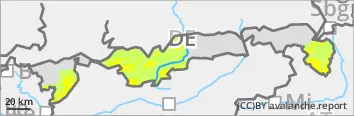
Danger level
 | 1600m |
|  |
|  |
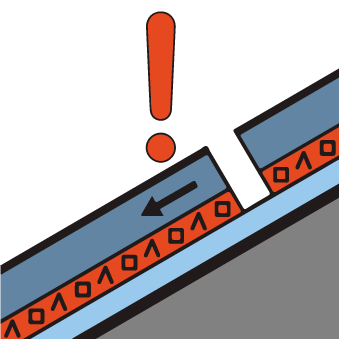

Weak layers in persistent weak layers remain triggerable.
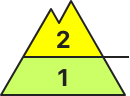
The avalanche danger is moderate above 1600 metres and low below that. The main problem is a persistent weak layer. Dry slab avalanches can be triggered in places by a small additional load. Avalanche prone locations can be found at the transition from little to much snow, for example at the entrance to gullies and bowls. Slab avalanches can reach medium size, especially on snowy eastern and northern slopes.
Snowpack
Above approx. 1600 m, bonded snow lies on built-up layers, often in the area of harsch crusts. These layers are still prone to triggering in places. The snowpack base consists mainly of faceted crystals. Up to medium altitudes, the snow surface is dominated by partly stable crust and thin breakable crust at higher altitudes. On the sunny slopes, it is frozen hard in the morning and firns up during the daytime changes. At the highest elevations, there is some fresh wind slab on a small scale. The snow depths are below average.
Tendency
The persistent weak layer problem remains for the time being.