Beware of prone to triggering persistent weak layers in the high altitudes!
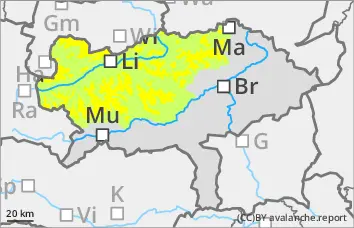
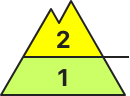
The avalanche danger is assessed as moderate above 1,800 metres and low below that. Slab avalanches can be triggered in some places even with little additional load and can reach medium size when breaking through the persistent weak layer. The danger areas are located in particular in the north-west to east aspects behind ridgelines and terrain edges as well as in the entrance areas to steep gullies and bowls. In particular, transitions from a little to a lot of snow and the edges of fresh and older snow packs should be avoided.
Snowpack
At high altitudes, fresh and older wind slab snow lies in the extended north and east exposures on an unstable snow cover, snowpack with weak layers of faceted crystals and floating snow. Fresh and older drift snow packs form the snow slab on the existing weak layers and are prone to triggering. On the sunny slopes, the snow cover, snowpack is mostly settled and quite compact. On the sunny slopes, the slopes in some regions are bare up to 2000 metres.
Tendency
No change in avalanche danger. Partly strong southerly winds in dry air. No snow in sight at the moment!
Danger level
1800m
Avalanche Problem
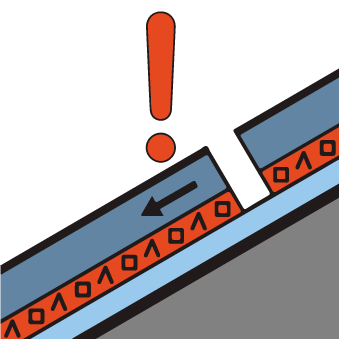
Persistent weak layer
1800m
Areas prone to triggering due to weak layers in the persistent weak layer
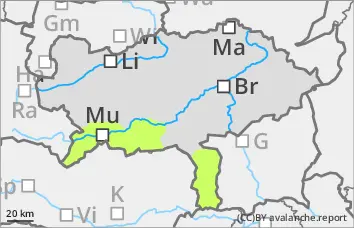
The avalanche danger is assessed as low. Slab avalanches can still be triggered in a few places with little additional load, but usually remain small. The danger areas are located in particular in the north-west to east aspects behind ridgelines and terrain edges as well as in the entrance areas to steep gullies and bowls. Prone to triggering is greatest at the transition from a little to a lot of snow and in the edge areas of fresh and older snow packs.
Snowpack
At high altitudes, fresh and older wind slab snow lies in the extended northern and eastern exposures on an unstable snow cover, snowpack with weak layers of faceted crystals and floating snow. Snowdrift accumulations form the snow slab on the existing weak layers and are sometimes prone to disruption. On the sunny slopes, the snow cover, snowpack is mostly settled and quite compact. The snow depths are still below average.
Tendency
No change in avalanche danger. Partly strong southerly winds in dry air. No snow in sight at the moment!
Danger level
Avalanche Problem
Persistent weak layer
Low avalanche danger, isolated avalanche prone locations in shady slopes
The avalanche danger is low. In extremely steep and shady slopes above the tree line, the triggering of small slab avalanches cannot be completely ruled out. The risk of injury and falling generally outweighs the risk of burial. In general, be careful in the hardness or icy entrance areas to steep gullies. Especially in the extended northern exposures, fresh, thin snowdrift accumulations can cover the icy areas.
Snowpack
The snow surface is crusted and hard, during the day it hardly softens even on the sunny slopes. The snow base, fundament is usually set and compact. In extremely steep shady-slope gullies, the snow base, fundament can be partially weakened by angular shapes, but these areas are rare. In general, the snow cover is below average, with often only a few centimetres of snow covering the ground below the tree line.
Tendency
No change in avalanche danger. Partly strong southerly winds in dry air. No snow in sight at the moment!