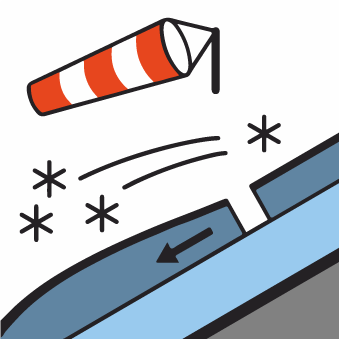
Due to new fallen snow and strong winds there is fresh wind slab!
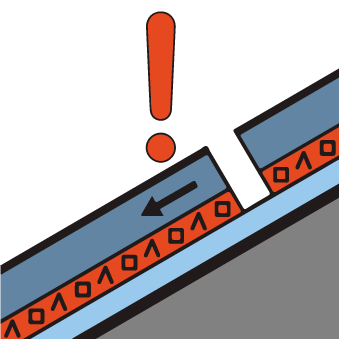
This is particularly important where the fresh wind slab lies on a hardness of old snowpack. In steep terrain, small to rarely medium slab avalanches can be triggered by even a small additional load. Avalanche prone locations are usually easy to recognise and should be avoided. Be aware of the risk of falling on the hard old snowpack.
Snowpack
Around 10 cm of new fallen snow is expected. Fresh snowdrift accumulations are forming due to strong north-westerly winds. Where the drifts lie on a hardness of old snowpack, the binding is not sufficient. The thin snow base, fundament contains faceted crystals that have been transformed by building up. Surface hoar can be covered. The snow depths are very below average, even at high altitudes. Below this, the new fallen snow comes to rest on bare ground.
Tendency
No significant change in the snow and avalanche situation. There will be some new fallen snow from Wednesday evening.
Danger level
2200m
Avalanche Problem
Wind slab
2200m
Persistent weak layer
2600m
Prone to triggering fresh wind slab.
The avalanche danger is moderate. Fresh wind slabs are formed by storms from the north-west. This falls on an unfavourably built-up old snow surface and is prone to triggering. Small avalanches in particular can be triggered by a single person in some places from around 2200 metres. Take particular care in terrain traps, areas adjacent to the ridgeline, crests or summits and in gullies and bowls.
Snowpack
The snow cover, snowpack is highly variable. In high, shady slopes, the melt-freeze crust usually consists of edged snow with no binding. Due to the overall highly built-up transformed snow cover, the potential for fracture propagation is generally low. Fractures are most possible in fresh wind slab snow, above the hard old snow foundation from early winter, or very rarely in the vicinity of crusts. The snow depth is well below average at all altitudes.
Tendency
The avalanche danger increases slightly with more new fallen snow and wind on Wednesday.
Danger level
treeline
Avalanche Problem
Wind slab
Treeline
Avalanche danger increases above the tree line with new fallen snow and wind
There is a moderate avalanche risk above the tree line. New fallen snow and sometimes stormy north-westerly winds create fresh snowdrift accumulations. Especially behind broad ridges and ridgelines as well as in gullies and bowls, these can be disturbed in places by individuals and triggered as small to medium-sized slab avalanches. The avalanche prone locations are usually easy to recognise if visibility is good. Apere areas are covered by new fallen snow, making it difficult to recognise the risk of injury.
Snowpack
Under the influence of strong winds, 5 - 15 cm of new fallen snow, locally even more, falls on a crusted can form old snowpack. In many places, a built-up transformed surface or surface hoar is covered. The connection between the drift snow layer and the persistent weak layer is poor. On the shady slopes, there are sometimes weak layers of faceted crystals in the old snow foundation. At lower altitudes, the snow often falls on apery ground.
Tendency
It will remain windy and cold on New Year's Eve, with a few centimetres of new fallen snow again along the northern side of the Alps. Watch out for the wind slab problem!
Danger level
Not much snow. Low avalanche danger.
Isolated avalanches can be triggered in extremely steep terrain. Most releases are mostly small. Risks of falls and injuries outweigh those of being buried in snow masses.
Snowpack
The old snowpack is superficially melt-freeze encrusted and generally hardened. The crust softens up slightly during the daytime hours, particularly on sunny slopes. South-facing slopes are bare of snow up to high altitudes. Only limited information from outlying terrain is currently available to the Avalanche Warning Services.
Tendency
No significant change anticipated. Low avalanche danger will continue.
Danger level
2000m
Avalanche Problem
Persistent weak layer
2000m
Wind slab
Treeline
The danger of Avalanche is low. Be careful in fresh snowdrift accumulations!
Snowpack is mostly stable. In some places in the high alpine regions, especially on fresh drifts of blown snow, a small, clustered Avalanche can be triggered under higher loads.
Snowpack
dp.4: cold following warm / warm following cold
There is little snow, and the peaks and ridges are in some places blown bare. During the last deterioration, about 10 cm of New fallen snow fell, on Sunny slope below 2000 m on terrestrial ground.
In the high alpine regions, weak layers may be present in the old snowpack.
On prominent areas, the snow has become heavier during the day and drifts are forming at night.
Tendency
Wednesday and Thursday will see less sunshine and more cold and windy conditions.
Danger level
Danger of falling on hard old snow surface
The avalanche danger is low. Avalanches are hardly to be expected.
Snowpack
A few centimetres of new fallen snow fall on an often load-bearing melt-freeze crust or, on sunny slopes, up to high altitudes on the ground that is already covered with snow. On purely shady slopes, the old melt-freeze crust is sometimes not load-bearing and garnished with built-up snow or surface hoar. At higher and higher altitudes, faceted crystals can be found beneath the melt-freeze crust.
Tendency
The avalanche danger remains low for the time being.
Danger level
treeline
Avalanche Problem
Wind slab
Treeline
Low avalanche danger, fresh avalanche prone locations due to wind slab.
The avalanche danger is generally low. With new fallen snow and sometimes stormy north-westerly winds, fresh snowdrift accumulations are occasionally formed adjacent to the crest, which can be triggered as small ridgelines, crests or summits with little additional load. This is particularly the case behind broad ridges and crests as well as in gullies and bowls.
Snowpack
Under the influence of strong winds, up to 10 cm of new snow falls on a crusted old snowpack. In many places, a built-up transformed surface or surface hoar is covered. The connection between the drifting snow layer and the persistent weak layer is poor. At lower altitudes, the snow often falls on apery ground.
Tendency
It will remain windy and cold on New Year's Eve. The wind slab problem remains predominant!
Danger level
Isolated avalanche prone locations occur in persistent weak layer of old snow.
In isolated cases avalanches can be triggered in persistent weak layers on very steep shady slopes in high alpine regions. These releases are mostly small-sized. The risks of falling and sustaining injuries outweigh those of being buried in snow masses. In ridgeline terrain, gullies and bowls at very high altitudes, freshly generated but usually small-sized snowdrift accumulations require attentiveness.
Snowpack
The old snowpack is superficially melt-freeze encrusted and iced over from place to place. The crust softens up slightly during the daytime hours, particularly on sunny slopes. On shady slopes beneath the melt-freeze crust, unbonded, mostly expansively metamorphosed crystals occur. At high altitudes, small-sized snowdrift accumulations have been freshly generated. On shady slopes in high alpine regions there are still weak layers inside the snowpack, and frequently surface hoar. South-facing slopes are bare of snow up to high altitudes. Only limited information from outlying terrain is currently available to the Avalanche Warning Services.
Tendency
Avalanche danger expected to remain low
Danger level
Watch out locally for small snowdrift accumulations.
New fallen snow is being transported by north-westerly winds onto mostly loose ground. The risk of burial outweighs the risk of injury from stones underneath, the avalanche risk is low.
Snowpack
In some areas, up to 15 cm of new or wind slab snow is falling on apery ground.
Tendency
The avalanche danger remains low despite the increase in fresh snow and wind on Wednesday.
Danger level
Rare release points and risk of injury from stones.
The risk of avalanches is low, but injury from stones and falling remain the main dangers. In
gullies and bowls adjacent to the ridgeline, crests or summits in shady slopes, there are very occasional difficult to
points in the persistent weak layer. Only very rarely can drift snow packs be triggered by individual
triggered by individuals. Avalanches remain small.
Snowpack
There is a below-average amount of snow and the snow cover, snowpack is highly variable in the interior. In
shady slopes, there are isolated weak layers of faceted crystals in the snow cover, snowpack
mostly in the vicinity of crusts. Due to the overall strongly built up
snow cover, the potential for fracture propagation is generally low.
Tendency
The avalanche danger remains low on Wednesday.
Danger level
2200m
Avalanche Problem
Wind slab
2200m
Fresh wind slab prone to triggering.
With new fallen snow and a stormy wind from the north-west, fresh prone to triggering snow packs are formed, which can be triggered by individuals in a few places from around 2200 metres. They are deposited on an unfavourably building snow cover, snowpack. Where there is more precipitation locally, enough snow can accumulate to bury people, especially in terrain traps. Take care behind exposed ridges and ridgelines, in gullies and bowls. In shady slopes at high altitudes, there are still very occasional release points in persistent weak layers that are difficult to disturb. The risk of injury from stones is not easily recognisable everywhere.
Snowpack
Fresh windslab snow is deposited on the highly variable and crusted old snowpack, more in the north than in the south. The connection is generally rather poor. In shady slopes, weak layers of faceted crystals are occasionally preserved in the snow cover, mostly in the vicinity of crusts. Due to the overall heavily built-up transformed snow cover, the fracture propagation potential in the persistent weak layer is generally low.
Tendency
The avalanche danger increases slightly with more new fallen snow and wind on Wednesday.