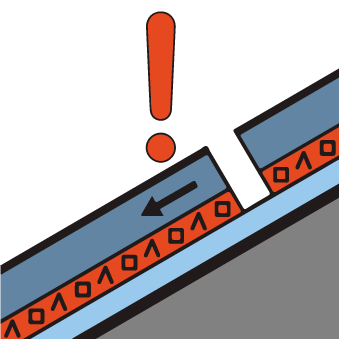
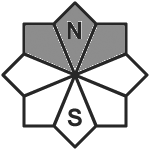
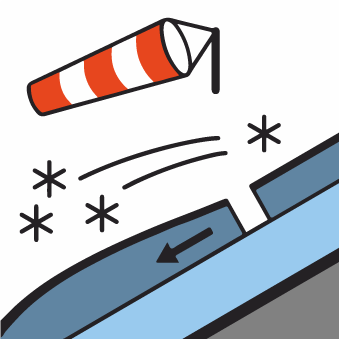
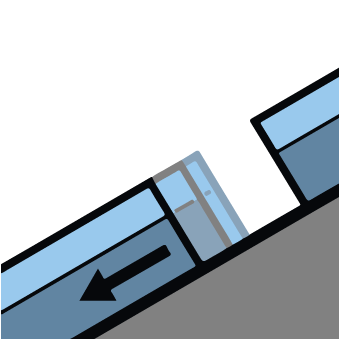
Avalanches can be triggered in the persistent weak layer in isolated cases on very steep shady slopes. These releases are usually small-sized. The risks of injuries from being forced to take a fall outweigh those of being buried in snow masses. Freshly generated, small-sized snowdrift accumulations are prone to triggering and require attentiveness. Isolated, usually small-sized glide-snow avalanches are still possible on steep smooth slopes which have not yet discharged.
Snowpack
The shallow snowpack is well consolidated for the most part, and low in tensions. On shady slopes in high alpine regions, isolated weak layers inside the snowpack occur. As a result of intermittently strong foehn winds, loose old snow was transported from place to place and generated small-sized snowdrifts at high altitudes. There is currently limited information from outlying terrain available to the Avalanche Warning Service.
Tendency
Avalanche danger not expected to change significantly
Danger level
Not much snow. Low avalanche danger.
Low avalanche danger prevails. Isolated small-sized glide-snow avalanches are possible on steep smooth slopes which have not yet discharged. Glide cracks are signals of potential imminent danger. On very steep shady slopes above appx. 2200m isolated avalanches can be triggered in the weak old snow, they remain small-sized for the most part. The risks of falling and sustaining injuries outweigh those of being buried in snow masses.
Snowpack
There is very little snow on the ground. South-facing slopes are bare of snow up to high altitudes. During the nighttime hours, a breakable to capable-of-bearing-loads crust can form. During the day it softens up, particularly on sunny slopes and at low altitudes.
Tendency
Avalanche danger not expected to change significantly
Danger level
2600m
Avalanche Problem
Wind slab
2600m
Persistent weak layer
2600m
Some drift snow and rare avalanche prone locations in old snow
The avalanche danger is low. A few centimetres of new fallen snow will be transported by the southerly foehn. On the north side, the drifting snow packs present from around 2600 m are growing slightly as a result. Small and near-surface avalanches in particular can be triggered by individuals in a few places, in particular in extremely steep gullies and bowls and behind ridgelines. In these areas, there are still isolated trigger points for small avalanches in the old snow.
Snowpack
The snow cover, snowpack is moist or even wet due to heat and rain up to medium to high altitudes and outgoing longwave radiation is reduced at night. At shady high altitudes, there are angular crystals both near the surface and within the snow cover, which can occasionally serve as a weak layer. This is particularly the case near crusts. Above this, some drift snow has been deposited, especially on the north side. The snow depth is well below average at all altitudes.
Tendency
The avalanche danger remains low.
Danger level
Avalanche Problem
Gliding snow
Injury from stones and falling are the main dangers.
The avalanche danger is low. Small gliding avalanches can spontaneously release from the north-facing slopes that have not yet been discharged. In shady high altitudes, there are still isolated avalanche prone locations for small slab avalanches that are difficult to trigger in the old snow, especially in gullies and bowls adjacent to the ridgeline, crest or summit. Stones may be covered by a few centimetres of new or drift snow at high altitudes.
Snowpack
The snow depth is well below average for the time of year, low elevations and the sunny slopes are widely covered in snow. Due to heat and rain, the snow cover, snowpack is moist or even wet up to high altitudes and outgoing longwave radiation is reduced at night. In shady slopes at high altitudes, weak layers of angular crystals are still occasionally preserved in the snow cover, mostly in the vicinity of crusts. Especially in the northern Alps, the surface can also be icy here.
Tendency
The avalanche danger remains low.
Danger level
The risk of falling and being swept away is greater than the risk of burial.
The avalanche risk is low. On very steep, smooth slopes such as meadows or sparse forest areas, small gliding avalanches can occasionally trigger themselves.
Above 2200 m, old snow can occasionally be problematic. With a large additional load, small slab avalanches can be triggered on extremely steep slopes in northern aspects.
Snowpack
In the morning, the snow surface is partially solidified. It softens quickly on sunny slopes during the day, but remains hard and icy on the shady slopes. Above 2200 m, only a few weak, built-up layers can be found in the upper half metre of the snow cover, snowpack on the shady slopes. The base of the snowpack is often wet. There is little snow, on the south side the ground is snowed out far up.
Tendency
The avalanche danger remains low.
Danger level
Avalanche Problem
Persistent weak layer
The danger of avalanches is low.
Snowpack is mostly stable. In arid areas above the forest line, weak layers may be present in the snowpack. In a few places in the high alpine regions, a small, clustered avalanche may be triggered under higher loads. Some creeping of dry, untracked new fallen snow is possible.
Snowpack
dp.4: cold following warm / warm following cold
Snowpack is mostly stable, with significant snowmelt on sunny slopes. On the sunny slopes, the old snow base is hard in many places. In the osoles, weak layers may be present in the Old snow cover. Up to 10 cm of New fallen snow has fallen on the old snow base, with the snowfall level around 1800 m above sea level.
Tendency
Friday will see more clarity in the mountains, with a weak to moderate westerly wind that will weaken during the day. Temperatures will be 4 °C at 1500 m and -1 °C at 2500 m.