The avalanche danger is moderate above 2200 metres and low below. Old snow is the main problem. Slab avalanches can be triggered at high altitudes on very steep slopes in the northern exposures, especially with high additional loads. More extensive break propagation and thus medium-sized avalanches are possible in wind-protected hollows. Otherwise, avalanches usually remain small and the risk of falling must be taken into account.
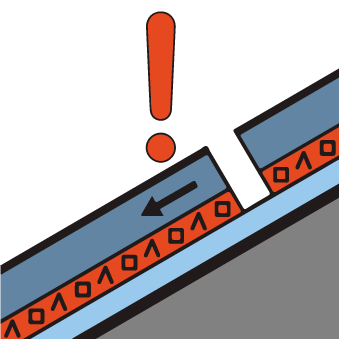
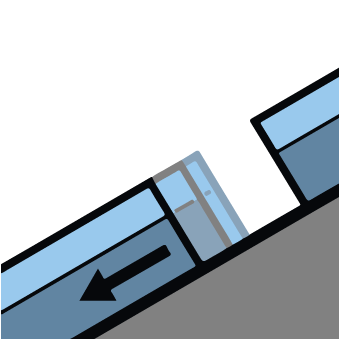
Individual sliding snow avalanches can spontaneously slide down extremely steep slopes with smooth ground that have not yet been discharged. These are usually small.
Snowpack
Due to a lack of radiation, the snow does not freeze through at lower altitudes; during the day, the snow cover softens, especially on the sunny side. At higher altitudes, the snow cover on open areas is hardened and icy. At the highest summits, the snow cover becomes thinner and is not stable everywhere on the shaded side. Here, the snow underneath the snow cover has an angular structure. In places, the upper half metre of snow still has a layer of rime that is prone to disruption. Sliding movements still occur occasionally on smooth ground. On the south side, the ground is increasingly pitting in the middle layers.
Tendency
The old snow problem is slowly becoming less acute.
Danger level
2400m
Avalanche Problem
Persistent weak layer
2400m
Gliding snow
2200m
Isolated glide-snow avalanches. Danger zones in persistent weak layers
Avalanches can be triggered by one sole winter sports enthusiast above 2400m on very steep shady slopes. These releases remain small to medium sized, in isolated cases. As a result of daytime warming and solar radiation, generally only small wet-snow avalanches are possible. Small glide-snow avalanches continue to trigger naturally on steep, smooth-ground slopes which have not yet discharged.
Snowpack
Up to higher altitudes, the snowpack has been weakened by rain impact. Nocturnal outgoing radiation is adequate particularly in the latter part of the night, the snowpack can consolidate superficially. During the course of the day, it softens up especially on sunny slopes and at lower altitudes and the danger of wet-snow avalanches again rises. On shady high-altitude slopes above 2400m, weak layers are still evident inside the snowpack.
Tendency
The receding problem of persistent weak layers is slowly improving the avalanche situation.
EARLIER Danger level
1700m
Avalanche Problem
Wet snow
1700m
Persistent weak layer
Treeline
LATER Danger level
1700m
Avalanche Problem
Wet snow
1700m
Persistent weak layer
Treeline
If the weather is sunny, the risk of avalanches on steep slopes will increase slightly during the day.
Warm and sunny weather may still lead to spontaneous small avalanches of wet snow on steep slopes during the day. The probability of triggering will decrease rapidly in the evening.
In arid areas above the tree line, weak layers are present in the snow cover. In a few places, a small to medium sized avalanche may be triggered under higher loads.
Snowpack
dp.4: cold following warm / warm following cold
In sunny weather, the crust strengthens at low altitudes and softens during the day. In shadier and sheltered areas, the snow cover remains more loose and dry. Mostly, however, it is increasingly transformed by wind and sun. In arid regions, weak layers may be present in the snow cover.
Tendency
The weekend will continue with sunny weather, especially on Saturday, with some clouds in the sky, occasionally thickening and causing diffuse light. Temperatures will strengthen. During the day, snow cover will become more pronounced and slightly less stable on sloping terrain, while snow on sloping terrain will melt and slowly melt.
Danger level
2200m
Avalanche Problem
Gliding snow
2200m
Very compact, stable snow cover
The avalanche danger is low. Individual small sliding snow avalanches can occur spontaneously on extremely steep, smooth meadow slopes.
Snowpack
On the shady side, the snow is compact, hardened and partly icy right up to the higher altitudes. During the day, the remaining snow cover softens on the surface with the sun. The base of the snowpack is often wet. At the highest altitudes, a layer of angular crystals has formed underneath the dominating snow cover. The snowpack is thin overall. The middle layers are increasingly thinning out on the sunny side.
Tendency
The avalanche danger remains low.
Danger level
2600m
Avalanche Problem
Persistent weak layer
2600m
Gliding snow
2400m
Individual sliding snow avalanches, isolated danger spots in old snow
The risk of avalanches is low, the risk of falling is higher than the risk of burial.
Occasionally, a snow slab can be triggered by a single winter sports enthusiast above 2500 metres. The avalanches usually remain small. The main danger spots are on extremely steep, shady slopes.
Small, spontaneous sliding snow avalanches are possible from very steep, not yet unloaded grass mat terrain.
Snowpack
The surface is dominated by (fractured) hardpack or crusts, some of which soften during the day. From around 2500 m, there are angular crystals within the snowpack near the crusts, which can occasionally serve as a weak layer. Below this, the snow cover is stable and is most likely to slide off the ground. Overall, there is very little snow, and on the sunny side, it is bare far up.
Tendency
Little change.
Danger level
Avalanche Problem
Gliding snow
Falls and stones are the main danger.
The avalanche danger is low. Small, spontaneous sliding snow avalanches are possible from very steep, as yet undischarged grass mat terrain.
Snowpack
There is often little snow, low elevations are widely covered in snow. The snow surface is hardened and softens during the day at medium altitudes and also at high altitudes on the sunny side. Inside, the snow cover is moist to wet up to high altitudes. In shady, high and high alpine locations, there are still isolated weak layers of angular crystals in the snowpack.
Tendency
Little change, the avalanche danger remains low.
Danger level
Avalanche Problem
Gliding snow
Not much snow. Low avalanche danger.
As a result of daytime warming and solar radiation, isolated small-sized wet-snow avalanches are possible. Small glide-snow avalanches can still slide away naturally on steep smooth slopes which have not yet discharged.
Snowpack
The snowpack has been weakened by rain impact up to higher altitudes. Nocturnal outgoing radiation is adequate particularly in the latter part of the night, the snowpack can consolidate superficially. During the course of the day, it softens up especially on sunny slopes and at lower altitudes and the danger of wet-snow avalanches again rises.
Tendency
Little change is expected, avalanche danger remains low