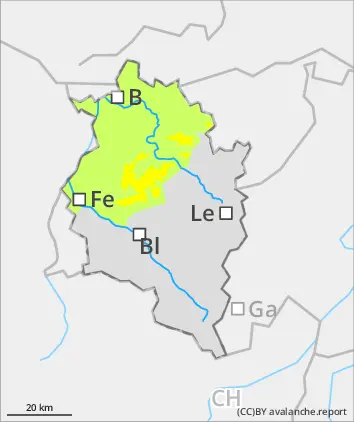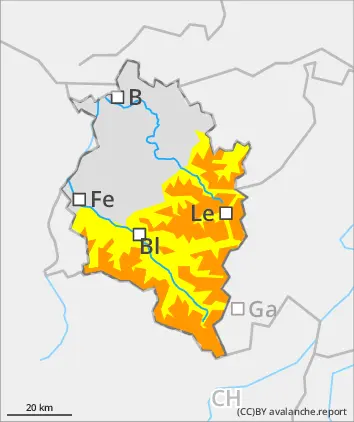
Danger level
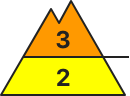 | 2000m |
| 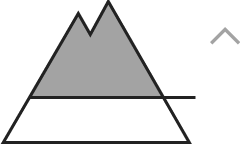 |
|  | ||||
|  |  |
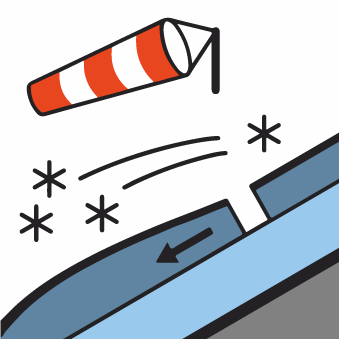
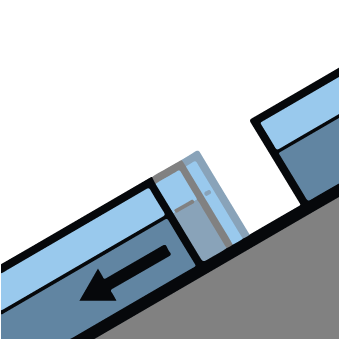

Fresh snowdrifts prone to triggering
Trigger-sensitive snowdrift accumulations are threatening. The accumulations can be easily triggered even by one sole skier. Danger zones occur in wind-loaded steep terrain, in gullies and bowls, and behind protruberances in the landscape. Size and frequency of danger zones tend to increase with ascending altitude. In addition, on steep shady slopes at high altitudes and in transitions from shallow to deep snow, isolated slab avalanches can be triggered by large additional loading. In zones where there has been rain impact, slides and small wet-snow avalanches are possible. Glide-snow avalanches, mostly small, continue to be possible. Caution urged below glide cracks.
Snowpack
Fresh snow and loosely-packed older snow will be transported widespread at high altitudes. Fresh and older, covered snowdrift accumulations are prone to triggering. The old snowpack is weakened up to high altitudes, at lower altitudes the surface is often melt-freeze encrusted, often layers of graupel are blanketed. Covered deeper layers in the old snowpack are generally compact and unlikely to trigger, mostly likely in places where the snow is shallow on very steep shady slopes.
Tendency
Fresh snowdrift accumulations remain prone to trigger at high altitudes